
Selling on eBay UK in 2026 looks deceptively simple: list, ship, get paid. The reality is more layered. Since October 2024 the ebay uk selling fees structure split private and business sellers into separate lanes, HMRC requires anyone with over £1,000 a year in trading income to register for Self Assessment, and Action Fraud reports record marketplace scam volumes. This guide breaks down selling on ebay uk fees in plain English, compares them with Vinted UK and Facebook Marketplace, lists the seven scam patterns to recognise, and explains when "decluttering" becomes "trading" for HMRC.
The piece ends with a 30-second buyer-screening checklist, a side-by-side comparison of eBay UK vs Vinted UK vs Facebook Marketplace, and a section on protecting product photography from theft. If you sell more than occasionally, bookmark this page - rules around side hustle tax, UTR registration and DAC7 reporting changed materially in 2024-2025 and most older guides are out of date.
What is eBay UK and who should be selling there in 2026
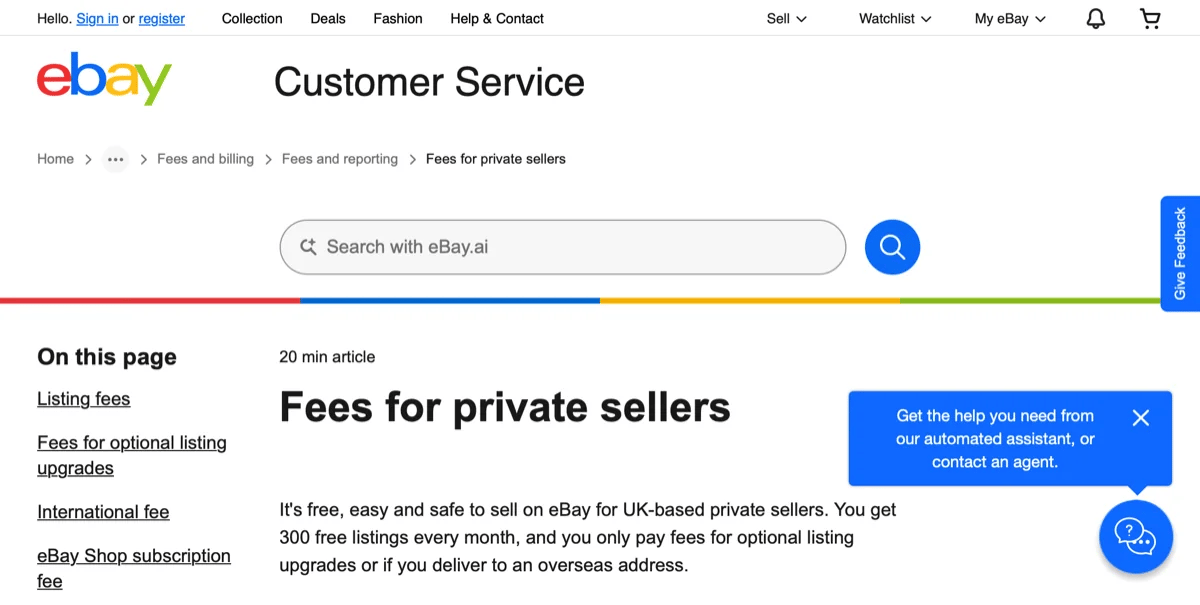
eBay UK is the British arm of the marketplace founded in 1995. It has roughly 27 million monthly active UK buyers, around 300,000 business sellers and tens of millions of private accounts. After the October 2024 restructure, the platform runs two lanes: a private seller lane with no listing fee and no Final Value Fee in most categories (the buyer pays a Buyer Protection fee at checkout), and a business seller lane with traditional category-based fees and monthly subscriptions.
It differs from Vinted (fashion-first, 0% to sellers) and Facebook Marketplace (free, no protection, mostly local pickup). Where eBay UK wins is breadth - cameras, antiques, car parts, trainers, used iPhones, all in one account with buyer protection, integrated postage labels and HMRC-compliant transaction history.
Who should be on eBay UK in 2026:
- Casual declutterers under £1,000/year - covered by HMRC's trading allowance, no Self Assessment
- Side hustlers £1,000-£12,500 from resale, eligible for trading allowance and possibly part-time status
- Small business sellers sourcing stock to resell, registered with HMRC and Companies House
- Specialist sellers in collectables, automotive parts, vintage clothing, vinyl, books, photography gear and DIY tools
- Estate clearance after house moves and bereavement - eBay handles the long tail Vinted will not touch
Consider Vinted UK or Facebook Marketplace instead for: women's and children's clothing (Vinted has owned that category since 2019), and bulky local-pickup-only items like sofas and white goods (Facebook Marketplace dominates here).

eBay UK selling fees 2026 - real numbers and the calculator

The question almost everyone Googles first: how much are ebay selling fees uk in practice? Since October 2024 there are three answers depending on whether you are a private seller, a business seller, or selling cars and motors. The table below uses rates eBay UK published as of January 2026 - useful as a manual ebay uk selling fees calculator before you list.
| Seller type / category | Insertion fee | Final Value Fee | Per-order fee | Notes |
|---|---|---|---|---|
| Private seller, most categories | £0 (within free allowance) | 0% on item price | £0 | Buyer pays a 4% + 75p Buyer Protection fee instead |
| Private seller, Watches, Sneakers, Handbags | £0 | Up to 12.8% | 30p | Authenticity-checked categories |
| Business seller, Clothing/Accessories | 30p (above 1,000 free listings) | 13% up to £300 portion, 4% over | 30p | Plus optional store subscription |
| Business seller, Electronics | 30p | 10% up to £300, 3% over | 30p | Lower rate to compete with Amazon |
| Business seller, Most other categories | 30p | 12.8% up to £300, 3% over | 30p | The default rate |
| Cars, Motorcycles, Vans | £10 insertion (private), £15 (business) | £0 in most cases | £0 | No FVF on vehicle sales |
| Property | £35-£50 insertion | £0 | £0 | Listing-fee-only model |
The headline change for private sellers: since October 2024 selling fees on ebay uk for private accounts are 0% in most general categories. The buyer pays a Buyer Protection fee at checkout (around 4% + 75p) that funds eBay's Money Back Guarantee. That sounds free, but the buyer-side fee makes prices look 5% higher than the same item on Vinted, so price carefully.
Private sellers still pay an FVF in authenticity-checked categories: watches over £100, sneakers over £100, designer handbags over £500, trading cards over £150. There the FVF can hit 12.8% + 30p per sale, similar to business sellers. Electronics, fashion (non-luxury), books, home and garden, toys, collectables and vehicles are the truly fee-free private categories.
- Promoted Listings Standard: optional 2-12% ad fee, charged only when item sells through a promoted-slot click
- International postage: Global Shipping Programme adds buyer-paid charges, no extra seller fee
- Refunds: eBay refunds Buyer Protection fee to buyer; seller still owes the 30p per-order fee in applicable categories
- Below standard sellers: extra 6% fee for poor metrics, avoidable with tracked postage and prompt replies
- Store subscriptions: £20-£350/month for business sellers, reduce per-listing fees
For one-off sales, eBay's seller hub now includes an ebay uk selling fees calculator at the listing step. Third-party calculators add postage, PayPal residual fees and Promoted Listings spend. Rule of thumb: plan for ~15% total cost of sale for business sellers in default categories, ~5% for private sellers (buyer-paid in fee-free categories). For vehicles, ebay car selling fees uk are insertion-fee-only at £10-£15, with no FVF on the sale price.
Selling without registering a business 2026 - the £1,000 HMRC trading allowance

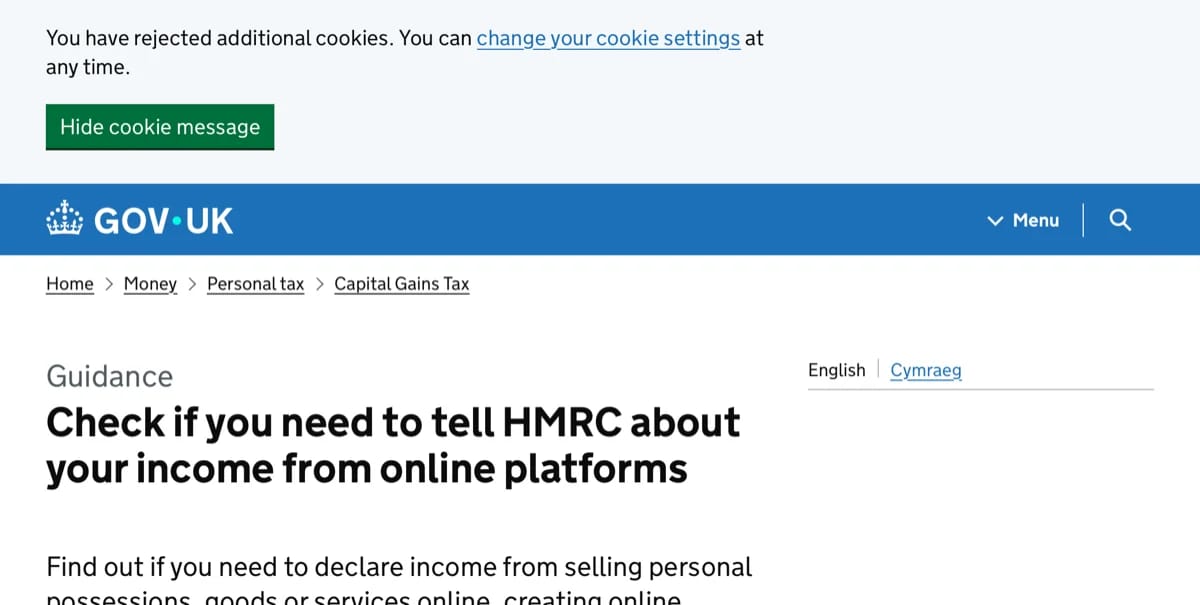
You do not need a registered business to sell on eBay UK as a private seller. HMRC allows up to £1,000 of trading income per tax year tax-free under the trading allowance - no Self Assessment, no UTR (Unique Taxpayer Reference), no income tax on those profits.
Crucially, selling personal possessions you used yourself is not "trading" in HMRC's view, regardless of value. Old wardrobes, inherited cameras, unwanted gifts all sit outside the trading allowance because no profit motive existed when you acquired them. The £1,000 clock starts the moment you buy things to resell.
What changed in January 2024: eBay (plus Vinted, Etsy, Depop, Airbnb, Uber) must now report seller earnings to HMRC under DAC7. The reporting threshold is 30 transactions or €2,000 (~£1,725) in a calendar year. Cross it and the platform sends your name, address, NI number, receipts and fees to HMRC by 31 January. The "side hustle tax 2024" rumours are this: the tax has not changed, HMRC's visibility has.
- Under £1,000 trading income: no action needed, no UTR, no Self Assessment
- £1,000 to ~£85,000: register as a sole trader with HMRC, file Self Assessment by 31 January, pay income tax and Class 4 NI on profit above the trading allowance
- Above £90,000 turnover: VAT registration mandatory, charge VAT on UK sales
- Limited company route: incorporate at Companies House, corporation tax 19-25% plus director PAYE - usually worth it above ~£30,000 profit
- Selling personal items: not trading, not counted toward the £1,000 limit, but DAC7 reporting still applies above 30 transactions
Mental model: bought to use, sold later because no longer needed = decluttering. Bought to flip, even occasionally = trading, and the £1,000 clock starts on the first such sale.

How to list on eBay UK step by step - and why photos make or break it
Listing an item on eBay UK in 2026 takes about ten minutes if photos are ready. The mobile app reads barcodes, ISBNs and product names from photos and pre-fills item specifics. Order: photograph first, draft second, finalise after a sleep.
Step one - photography. eBay shows up to twelve images and the algorithm rewards listings using most slots. The first photo appears in search results and watch lists; a clean white background converts better than a busy bedroom shot.
Step two - title. eBay UK gives you 80 characters; use them. Format: Brand + Model + Key spec + Condition + Year/Size, e.g. "Sony A7 IV Mirrorless Camera Body 33MP Full Frame Excellent Condition Boxed". Avoid emojis, exclamation marks and ALL CAPS.

Step three - item specifics. Fill every relevant field (brand, model, condition, size, colour, material) even if redundant with the title. Listings with all item specifics complete appear in 30-40% more filtered searches.
- Photo 1: clean front-on shot on white/neutral background, fills the frame
- Photos 2-4: 45-degree angles showing depth and proportions
- Photos 5-8: close-ups of wear, scratches, branding - honesty prevents returns
- Photos 9-10: scale reference, original packaging if any
- Photos 11-12: lifestyle shot, only if relevant
- Description: 150-300 words, dimensions, material, age, country of manufacture, flaws explicit
- Postage: offer at least one tracked option (Royal Mail Tracked 48 or Evri) plus collection-only for fragile items
Step four - pricing. Use eBay's "Sold listings" filter to see what comparable items actually fetched in 90 days, not asking prices. Price 5-10% above your floor and enable Best Offer - ~60% of buyers expect to negotiate on items above £30.
Royal Mail, Evri, ParcelForce and DPD - choosing eBay UK postage in 2026

eBay UK's integrated label printing beats post office counter prices. Four mainstream options in 2026: Royal Mail (small parcels and letters), Evri (cheapest under 5kg with drop-off shops), ParcelForce (large or time-guaranteed) and DPD (high-value with one-hour windows).
The single most common mistake: untracked postage on items above £20. Without tracking, Money Back Guarantee falls in the buyer's favour on any non-receipt claim. Always use tracked above £20, signed-for above £100.
- Royal Mail Tracked 48: best general-purpose, ~£3.50-£5 small parcels, drops at any post office
- Evri Standard Parcel: cheapest 0.5-5kg at ~£2.50-£4.50, corner shop drop-off, slowest claims if lost
- ParcelForce 48: best above 5kg, faster than Evri for heavy items
- DPD Next Day: high-value above £150, one-hour delivery window, photo-on-doorstep proof
- Royal Mail Special Delivery Guaranteed: required above £500, £500-£2,500 cover included

eBay UK and Facebook Marketplace - which to use for which item

Facebook Marketplace is the UK's second most-used selling platform after eBay - free to list, no sale fees, integrated with Messenger. The hard limit: no buyer protection, no seller protection, no integrated payment. Every transaction is two strangers using cash, bank transfer or PayPal Friends and Family (uninsured by design). Great for sofas, fridges, garden equipment and large furniture collection-only; terrible for posted items.
- Sell on eBay UK: anything posted, anything above £30, niche categories like collectables and photography gear
- Sell on Facebook Marketplace: collection-only, large furniture, garden tools, plants, quick decluttering
- Sell on Vinted UK: women's and children's clothing, designer accessories under £500, occasional menswear
- Cross-list on all three: only for high-value rare items where exposure beats reply burden
Facebook also has the highest scam ratio: anecdotally around one in four messages on a popular item is a scammer asking for "your number to text directly" or offering payment via a bogus shipping service. eBay's built-in messaging and integrated payment filter ~90% of these.
eBay UK scams - seven patterns every seller and buyer must recognise

Action Fraud recorded over 360,000 cases of online shopping fraud in the year to September 2024, with eBay, Vinted and Facebook Marketplace the largest share. Most sellers hit at least one of these patterns in their first 50 transactions.
Pattern 1 - The PayPal hold scam ("payment is pending, send the item")
The buyer forwards a screenshot of an "Awaiting confirmation" PayPal email and pushes for urgent dispatch. The email is fake (typically from a domain like paypal-secure-confirm.com). Once shipped, no payment arrives. Defence: never ship until funds appear in your actual eBay/PayPal account opened directly. PayPal never holds payments waiting on tracking from buyers.
Pattern 2 - The "send to a different address" scam
Buyer pays through eBay correctly, then messages: "Please send to my parents' address in Manchester instead". Shipping to the messaged address voids Money Back Guarantee protection. The buyer then files "item not received" and the address-change message is held against you. Defence: always ship to the order screen address. If the buyer wants to change, ask them to cancel and re-order.
Pattern 3 - The fake "item not received" claim
Buyer receives the item, leaves no feedback, and weeks later files Item Not Received. Untracked postage = automatic refund from your funds. Tracked postage with "delivered" status that matches the registered postcode usually wins.
Pattern 4 - The empty box return
Buyer claims "not as described", opens a return, and ships back an empty box, a similar-weight brick, or a damaged swap. eBay's returns policy favours buyers, so defence is documentation: photograph and weigh before posting, film yourself opening returns, report swap-outs to Action Fraud.
Pattern 5 - The overpayment scam
Buyer "accidentally" pays £500 instead of £50 by off-platform bank transfer, asks you to refund the difference quickly. Original payment is fake or chargebacked; the refund leaves permanently. A money-mule tactic - never accept off-platform payment.
Pattern 6 - The fake checkout link by SMS or email
SMS: "Your eBay item has sold - log in to confirm delivery within 12 hours: ebay-orders.confirm-uk.net". The domain is not eBay's; logging in hands over credentials and saved card. eBay never asks you to confirm anything via SMS link - always go directly to ebay.co.uk.
Pattern 7 - The "I'm a buyer" Facebook impersonation
Mostly hits cross-listed Facebook items. Someone claims to be your eBay buyer and wants to "speed things up" off-platform, often forwarding a fake Royal Mail courier email asking for an extra fee. Defence: keep all communication inside eBay messages.
A defensive checklist that filters all seven
- Funds confirmed in your actual eBay/PayPal account before shipping
- Tracked postage above £20, signed-for above £100
- Ship only to the address shown in the eBay order screen
- Never click SMS or email links - log in directly at ebay.co.uk
- All communication inside eBay messages
- Photograph and weigh items before posting
- Report scams to Action Fraud (0300 123 2040) within 14 days
What to do if you have been scammed on eBay UK

The order of actions in the first 24 hours decides recovery or loss. Most cases go cold after 14 days when the Money Back Guarantee window closes.
- Open a case in the eBay Resolution Centre within 14 days - "Item not received" as buyer, "Buyer claim disputed" as seller
- Report to Action Fraud (actionfraud.police.uk or 0300 123 2040) - get a Crime Reference Number for bank refunds
- Card or PayPal chargeback if you paid by card and eBay refuses
- Save all evidence: messages, tracking, emails, item photos, weight, packaging, courier receipts
- Report to CIFAS if your identity was used
- Submit feedback after the dispute closes, not during
- Block the buyer permanently
Seller protection now explicitly covers fake "item not received" claims when tracking shows delivery to the registered address. Escalate to eBay agent review and they almost always rule for the seller. The buyer's only recourse is a card chargeback through their bank, which eBay also defends with full documentation.

Pricing a used item - five sources of data for an honest valuation

Pricing is where most sellers leak money. 30% above market means months on the shelf; 30% below means £20 left on a £100 sale. The right price is the average of five sources, all from the last 90 days.
- eBay sold listings: filter by Sold, 90 days, same condition - gospel for what items fetch
- Vinted UK: clothing, designer accessories, kids' items (prices skew lower than eBay)
- Facebook Marketplace recently sold in your local area - what cash-on-collection buyers pay
- Specialist sites: MPB/Wex Used (cameras), MusicMagpie (tech), CeX (electronics), Vestiaire (designer)
- Depreciation rule: lose 20% in year one, 10% per year after, works for most consumer goods
Average those and price 5-10% above as the asking price, leaving room for Best Offer. Items above £100 particularly benefit from this - 60% of buyers in that bracket expect to negotiate.

AI in eBay UK selling - titles, descriptions and images in 2026
eBay UK's built-in "magic listing" tool, rolled out late 2024, reads a single photograph and drafts a title, description and item specifics in 15 seconds. By 2026 around 40% of new private listings are partially AI-drafted. Good for first drafts, weak in predictable ways that hurt conversion.
- Use AI for: descriptions, SEO-friendly titles, category suggestions, item specifics from a photo
- Do not use AI for: product photos - eBay flags obviously-AI images and may delist them, and it kills trust if the real item looks different
- Always edit AI titles: models add filler like "great condition very nice" that wastes character space
- Always factcheck specs: AI invents model numbers, years and dimensions - verify every spec against the item
Crucially: AI does not replace good base photography. Image AI removes backgrounds but cannot fix focus, exposure or honest representation of wear from a blurry phone snap. The biggest investment a serious eBay UK seller can make is shooting proper product photographs in natural daylight on a clean white surface, or paying a small studio for high-value items running for months.
Relisting strategy - what to do with items that do not sell
If an item does not sell within 30 days, the issue is one of four things: title, photographs, price or category. Going through them in order solves ~80% of stuck listings.
- Title audit: use all 80 characters, include brand, model and key spec; check via eBay's "search this on eBay"
- Photo audit: replace the first photo - it is responsible for over 60% of click-through
- Price audit: check sold listings again, drop 10% if comparable items sold lower in 30 days
- Category audit: many items fit two or three categories; try a niche subcategory
- End and relist: refreshes search position; do this monthly for stuck listings
For items that still will not move after three audits, consider Vinted UK (clothing), Music Magpie (tech), local Facebook groups or charity shop donation. Dead inventory ties up time and visibility.
A 30-second checklist - scam or genuine buyer
When a new buyer messages, run through the following in 30 seconds. Three or more red flags = decline or block. The cost of declining a real-but-suspicious buyer is far less than completing a fraudulent transaction.
- Buyer asks to communicate outside eBay (WhatsApp, Facebook, email, phone)
- Buyer says "payment sent" but funds not visible in eBay/PayPal
- Buyer asks to ship to a different address than the order
- Brand new account (zero feedback) ordering above £100
- Urgency pressure: "needed tomorrow", "shipping today only"
- Buyer asks for tracking number before paying
- Bank transfer or PayPal Friends and Family proposed
- Overseas address on a UK-only listing
- Above-asking-price offer "to lock the deal" without negotiation
- Send-to-freight-forwarder request
- Negative feedback threats for non-immediate shipping
- "Courier" message asking for a delivery fee
- Links to "ebay-confirm" or similar non-eBay domains
One red flag is acceptable. Three or more is almost always fraud - block, report and move on.
- Green flags: 50+ feedback at 99%+, specific item questions, relevant use case, accepts stated postage, pays within the hour
- Yellow flags: zero feedback (might be new), collection request, bundle discount question, requests for extra photos
- Red flags: see the list above - any three together means decline
Protecting your product photos - watermarking and image theft on eBay UK
Shoot proper product photographs and expect them stolen by other sellers within weeks. eBay UK's image-matching catches exact duplicates but cropped or resampled copies slip through. Aliexpress dropshippers, Facebook Marketplace and Vinted resellers regularly lift photos from successful eBay listings.
Three layers of defence work in practice:
- Subtle watermark: small semi-transparent text in the bottom corner with your eBay handle - obvious watermarks hurt conversion
- Distinctive background: a unique surface, fabric or prop competitors do not have
- Monthly reverse image search: drop photos into Google Images to find unauthorised use; eBay's "Report Listing" removes obvious thefts within 48 hours
For high-value collectables, vintage cameras, designer items and rare books, professional product photography pays back several times over - the photos last for years and form your seller brand. marszalstudio offers UK eBay seller packshots compliant with eBay's image policy.
eBay UK vs Vinted vs Facebook Marketplace - which platform wins for what
By 2026 the three platforms have settled into clear lanes. Picking the right one often doubles the sale price.
| Platform | Seller fees | Best for | Buyer protection | Posting |
|---|---|---|---|---|
| eBay UK | 0% private (most categories), 12.8% + 30p business | Almost everything except womenswear and bulky pickup | Yes - Money Back Guarantee | Integrated discounted labels |
| Vinted UK | 0% to seller, buyer pays 5% + 70p Buyer Protection | Womenswear, kidswear, occasional menswear | Yes - up to item value | Integrated Vinted Go labels |
| Facebook Marketplace UK | 0% | Sofas, white goods, bicycles, plants, large furniture | None | None - usually local pickup |
Optimum strategy for decluttering sellers: women's and children's clothing on Vinted, bulky collection items on Facebook Marketplace, everything else on eBay UK. Cross-listing creates message noise and double-sale risk. For business sellers with stock, eBay is the primary channel with Vinted as a secondary outlet for clothing.
What is prohibited on eBay UK - the restricted-items catalogue
Some categories are banned, others restricted, others verification-only. Listing a banned item triggers automatic removal and possible suspension. The most commonly tripped-over restrictions:
- Banned: live animals, drugs, human remains, stolen goods, counterfeits, weapons under the Offensive Weapons Act 2019, lock picks (non-locksmiths)
- Restricted: alcohol (licensed sellers only), tobacco (mostly banned), knives (age verified), pesticides (registered users), medical devices (CE/UKCA required)
- Special permission: firearms (RFD only), vehicles (extra verification), event tickets above face value (mostly blocked), cosmetics (CPSR required post-Brexit)
- Authenticity-checked: watches over £100, sneakers over £100, designer handbags over £500, trading cards over £150 - inspected before delivery
- Age-verified: 18+ items via Yoti or driving licence on the buyer side
Brexit added import/export restrictions on goods crossing UK-EU borders. CE/UKCA-marked items need the right certification, food/drink need import docs, lithium batteries face postage restrictions. Private sellers rarely hit these; business sellers shipping to the EU should know IOSS and OSS schemes.
- Check the UK Seller Centre prohibited-items list before listing high-value or unusual items
- Restricted items: upload documentation once at account level, not per listing
- EU buyers below €150: VAT-inclusive pricing under IOSS, eBay handles automatically
- Items above the £600 EU threshold: buyer pays duties at delivery
What is changing on eBay UK in 2026 - the calendar of updates
2026 brings several rule changes for both private and business sellers. Dates below reflect eBay UK's Seller Centre announcements as of January 2026.
- January 2026: First DAC7 reports for 2025 sent to HMRC by 31 January - sellers above 30 transactions or €2,000 get a confirmation email
- February 2026: Updated authenticity-check fees for watches, sneakers and handbags
- April 2026: HMRC trading allowance review - consultation on potentially raising the £1,000 threshold for inflation
- May 2026: New seller dashboard with integrated HMRC Self Assessment summary
- July 2026: Promoted Listings Advanced opens to private sellers with smaller daily budgets
- September 2026: Mandatory 2FA on all selling accounts
- October 2026: Money Back Guarantee window extended from 30 to 45 days for items above £500
- December 2026: Christmas listing fee waiver for new private sellers (repeat of 2024-2025)
The direction is clear: eBay UK is consolidating its private-seller-friendly model and tightening enforcement on undeclared business activity. Sell more than 30 items a year and are not registered with HMRC? The safest move in 2026 is to register before HMRC contacts you - the trading allowance still keeps the first £1,000 of profit tax-free.

Private sellers: 0% Final Value Fee in most general categories since October 2024 - the buyer pays a 4% + 75p Buyer Protection fee at checkout. Exceptions are authenticity-checked categories (watches over £100, sneakers over £100, designer handbags over £500, trading cards over £150) where private sellers still pay up to 12.8% + 30p per sale. Business sellers pay 12.8% on the first £300 plus 3% above, plus 30p per order, with reduced rates for clothing (13%) and electronics (10%). Vehicle sales are insertion-fee-only at £10-£15 with no FVF.
No, not if you sell under £1,000 of trading income per tax year - the HMRC trading allowance covers you, no Self Assessment required. Above £1,000 (and note: selling personal possessions is generally not "trading"), register as a sole trader with HMRC and they issue a UTR. You then file Self Assessment by 31 January. From January 2024 eBay reports earnings of sellers above 30 transactions or €2,000 directly to HMRC under DAC7.
Never ship until funds are visible in your eBay or PayPal account directly (not via email screenshots), always use tracked postage above £20 and signed-for above £100, ship only to the eBay order address, never click SMS or email links pretending to be eBay, keep all communication inside eBay messages. The seven most common scams: PayPal hold, "send to different address", fake item-not-received, empty-box returns, overpayment, fake checkout SMS, Facebook impersonation. Action Fraud (0300 123 2040) is the UK reporting line.
Vinted UK dominates womenswear, childrenswear and casual menswear with 0% seller fees (buyer pays 5% + 70p Buyer Protection). eBay UK wins for almost everything else: electronics, books, collectables, photography gear, automotive parts, antiques, large household items. Optimal strategy: clothing on Vinted, bulky local-pickup on Facebook Marketplace, everything else on eBay UK. Vinted is 2-3x faster for fashion but not designed for one-off non-clothing items.
The safest option is eBay's Managed Payments checkout - card or PayPal directly through eBay. Both are covered by Money Back Guarantee and seller protection. Dangerous options are anything off-platform: bank transfer, PayPal Friends and Family, BACS, cash via post, cheques, gift cards, crypto. As a buyer, paying by credit card adds Section 75 chargeback rights under the Consumer Credit Act 1974 over £100. As a seller, never accept payment outside eBay's checkout.
New private accounts typically start with a 10-item or £650 monthly limit, raised as you build feedback. Established private sellers usually get £30 of free listings monthly plus up to 1,000 free monthly listings before insertion fees. Business sellers with a Basic Shop (~£20/month) get 200 free listings, scaling to unlimited on Anchor and Enterprise tiers. Cars, motorcycles and property have separate limits and insertion fees. eBay reviews limits monthly based on performance metrics.
Selling personal possessions you used yourself (clothes, old gadgets, unwanted gifts) is generally not "trading" and not declarable, regardless of value. Buying items to resell (even occasionally) is trading income; HMRC's trading allowance keeps the first £1,000 per tax year tax-free without Self Assessment. Above £1,000, register as a sole trader and file Self Assessment by 31 January. From January 2024 eBay reports seller data to HMRC under DAC7 above 30 transactions or €2,000 - HMRC has visibility regardless, so register voluntarily once you are clearly trading.
Cross-listing only makes sense for high-value items where exposure justifies the reply burden. Facebook Marketplace has no buyer protection, no integrated payment and a much higher scam ratio - ~1 in 4 messages on a popular item is fraudulent. If you cross-list, only transact through eBay's checkout for posted items (Facebook for collection-only) and link Facebook back to your eBay listing rather than selling directly there. For volume sellers the time fielding Facebook scams usually outweighs the extra sales.
Summary - five things to remember about eBay UK in 2026
eBay UK in 2026 is a mature C2C marketplace: ~27 million active monthly buyers, 0% Final Value Fee for private sellers in most categories, 12.8% + 30p for business sellers. The three biggest stories: HMRC's DAC7 reporting now in full effect, consolidation of the private-seller fee waiver, and the rise of authenticity checks across watches, sneakers and handbags. Defensive strategy stays constant: never communicate or transact off-platform, tracked postage above £20, ship only to the registered eBay address, report scams to Action Fraud within 14 days. Knowing the seven scam patterns is the first line of defence.
One thing no fee-and-tax guide tells you: conversion on eBay UK is over 30% higher when listings use professional product photography. A title with brand, model and condition plus 8-12 well-lit photos on a neutral background doubles watch-list counts and final sale price. For valuable items - photography gear, vintage jewellery, designer fashion, collectables - invest in a proper packshot. marszalstudio runs UK eBay packshot sessions with same-week turnaround. AI cannot replace a good base photograph; a good base photo multiplied by AI editing is a serious edge in a 27-million-buyer market.
Further reading: UK product photography guide 2026 | Amazon UK product photo requirements | Selling on Vinted UK 2026 | TikTok Shop UK 2026 - sellers guide | HMRC side hustle tax 2026 explained