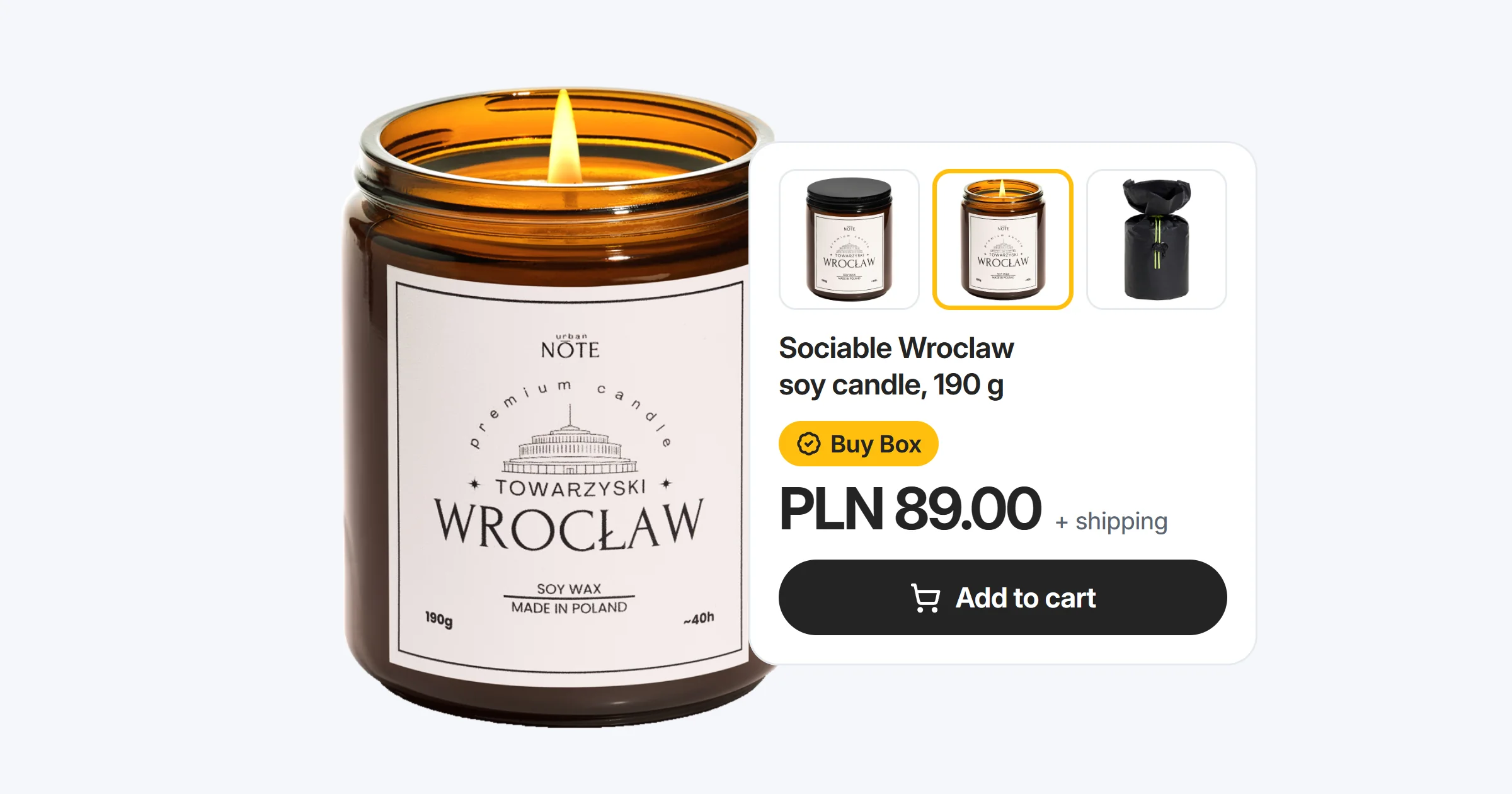
12 hours of live streaming. $830,000 in sales. One product sold every second. That was the record-breaking live session of Made by Mitchell, a two-person British cosmetics brand that in 2024 generated over 40 million pounds on TikTok Shop UK alone. This is not an anomaly. After five years of TikTok Shop in the United Kingdom, this is the new reality of discovery commerce - and the playbook for every UK seller who wants to grow in 2026.
TikTok Shop launched in the UK back in 2021, making Britain the first Western market where social commerce was tested at scale. Five years later the platform is no longer experimental. Globally TikTok Shop generated $64.3 billion GMV in 2025 (up 94% year-on-year), and the UK alone accounts for a significant share of that revenue. The forecast for 2026 is $112 billion globally. The platform has already overtaken Etsy and is closing in on Amazon in the impulse-purchase segment.
Here is the problem for UK sellers in 2026: the market is mature, saturated and ruthless. The early-adopter bonus is gone, the referral fee has risen to 9% for most categories, and more than 200,000 active UK merchants now compete for the same For You Page slots. If you joined in 2022 you grew on easy mode. If you are joining today, you need a precise optimisation playbook - not a motivational story.
This guide is that playbook. Seller Centre registration with HMRC and UTR, the real 9% + hidden costs, product photography specifications the algorithm actually rewards, shoppable video and live shopping tactics that work in 2026, the Creator Connect affiliate programme, Fulfilled by TikTok (FBT) UK logistics, case studies from Made by Mitchell and Hair Syrup to Luxe Collective, and twelve UK-specific FAQ answers. No fluff, just numbers that matter.

Table of contents
- What is TikTok Shop and why it redefined UK e-commerce
- TikTok Shop UK in 2026 - state of play after 5 years
- Social commerce in the UK - the market context
- TikTok Shop fees 2026 - the real 9% and the hidden costs
- TikTok Shop vs Amazon vs eBay vs Etsy for UK sellers
- TikTok Shop Seller Centre registration - step by step (HMRC, VAT, UTR)
- Product requirements and compliance - trademarks and safety standards
- Product photography specs - 5 to 9 images per listing
- Shoppable videos - format and strategy
- Live Shopping playbook - from zero to £1M
- The TikTok Shop algorithm and Seller Score
- TikTok Shop Creator Connect affiliate programme
- Logistics and Fulfilled by TikTok (FBT UK)
- Best-selling categories in the UK - beauty, fashion, wellness
- Case studies - UK, USA, Germany
- 7-step checklist for UK sellers in 2026
- FAQ - the 12 questions every UK seller asks
- Conclusion - winning the next 12 months
What is TikTok Shop and why it redefined UK e-commerce
TikTok Shop is the built-in commerce layer inside the TikTok app. Users can buy products directly from videos, live streams, the Shop tab and product cards without ever leaving the app. Discovery, consideration, checkout - all on one screen, in one session, in under sixty seconds. This is a fundamentally different model from every marketplace UK sellers grew up with.
Content-first versus search-first commerce
On Amazon UK or eBay, shoppers search for a specific product. They type a query, compare options and pick a winner. On TikTok Shop it works in reverse - the algorithm decides which products appear in front of which users, based on behavioural signals. The customer does not plan the purchase. They watch a 20-second clip, see a product in action and buy on impulse.
This is the mechanism called discovery commerce. The user is not actively hunting the product as they would on Google or Amazon. TikTok surfaces it during normal scrolling and the purchasing impulse arrives within seconds. That is why conversion rates on live streams routinely hit 10 to 15 percent - multiple times higher than static listings on Amazon or Shopify.
The practical consequence is that visual content quality decides the sale, not price or search ranking. Strong product photography and compelling short-form video are the foundation, not the finishing touch. Sellers who treat TikTok Shop like Amazon and upload weak packshots lose algorithmic visibility in the first week - and the algorithm rarely gives them a second chance.
TikTok Shop in numbers - global GMV growth
| Year | Global GMV (USD bn) | Year-on-year growth |
|---|---|---|
| 2023 | 20.0 | - |
| 2024 | 33.2 | +66% |
| 2025 | 64.3 | +94% |
| 2026 (forecast) | 112.2 | +74% |
The numbers are staggering. More than 15 million active sellers worldwide, annual sales growth above 120%, and TikTok targets $770 billion of retail spend across Europe and Japan within a 5-year horizon. This is no longer an experiment - it is a permanent sales channel growing faster than anything in the history of digital retail, including the early years of Amazon Marketplace.
Globally, the categories that convert best are beauty and personal care (22.5% of GMV, the undisputed leader), womenswear and lingerie (12.5%), health and wellness, consumer electronics accessories, homeware, food and supplements. The UK mirrors this ranking almost perfectly, with beauty dominating thanks to brands like Made by Mitchell, P.Louise and Hair Syrup having built the category template in 2023 and 2024.
TikTok Shop UK in 2026 - state of play after 5 years
TikTok Shop UK has been operational since 2021. In 2022 it expanded beyond invite-only status, in 2023 it went fully public for every registered UK merchant, and in 2024 and 2025 it matured into a competitive marketplace where the rules changed dramatically. If you joined in the first wave, you rode the algorithmic boost. If you are reading this in 2026, the game is different - and this section tells you exactly what changed.
What changed between 2022 and 2026
In 2022 the referral fee was 1.8% for most categories, the commission was waived on new seller sign-ups for the first 90 days and creator partnerships were easy to secure because very few brands were competing. Live shopping rooms regularly had five to ten thousand concurrent viewers because TikTok was aggressively pushing the feature into the For You Page.
By 2026 the picture is different. The standard referral fee is 9% across most categories, creator competition is intense (the best affiliate partners are locked in by large brands), and the algorithm rewards sellers with high Seller Score and consistent video output. Generic packshots and lazy listings get filtered out within days, not weeks. The barrier to entry has risen, but the payoff for doing it properly has risen with it.
| Metric | UK 2022 | UK 2024 | UK 2026 |
|---|---|---|---|
| Referral fee (beauty and fashion) | 1.8% | 5% | 9% |
| Active UK merchants | ~15,000 | ~120,000 | 200,000+ |
| Average creator affiliate rate | 5-8% | 10-15% | 10-20% |
| Minimum listing photos | 3 | 5 | 5 (9 recommended) |
| Live shopping barrier (followers) | 1,000 | 1,000 | 1,000 |
| Seller Score importance | Low | Medium | Critical |
Who is winning in 2026
Three types of sellers dominate TikTok Shop UK today. First, creator-led beauty and wellness brands with a visible founder on camera - Made by Mitchell, P.Louise, Hair Syrup, Bloom Nutrition. Second, fashion resellers and small-batch streetwear labels using regular live drops to create scarcity. Third, gadget and homeware importers running 3-5 live sessions per week with aggressive pricing and high shoppable-video output.
What unites them is the same pattern: a founder or ambassador visible on camera, consistent posting of 3 to 5 shoppable videos per week, at least 2 live sessions per week, and investment in professional base photography. Every winner in 2026 treats TikTok Shop like a broadcast channel, not a catalogue upload. The algorithm rewards broadcasters and punishes uploaders.

Social commerce in the UK - the market context
The UK is the most mature social commerce market in Europe. British e-commerce is worth approximately £120 billion a year, with online retail representing more than 27% of total retail spend - the highest proportion in Europe. Consumers here have been buying through Instagram Shopping, Pinterest and TikTok for years, which is exactly why the UK became TikTok Shop's first Western test bed.
Around 60% of UK internet users have now bought something through a social platform, and Gen Z buyers spend more time on TikTok than on any other commerce surface - including Amazon. In the beauty category alone, research shows that more than 30% of UK women aged 18 to 34 discover a new product on TikTok before buying it elsewhere, and a growing share now complete the purchase inside the app.
TikTok itself has over 24 million monthly active users in the UK, concentrated in the 16 to 44 age bracket. The average UK user spends around 80 minutes a day in the app. For any UK brand selling to Millennial or Gen Z buyers, ignoring TikTok Shop in 2026 is equivalent to ignoring Amazon in 2015. The channel is not optional - it is foundational.
TikTok Shop fees 2026 - the real 9% and the hidden costs
How much does it actually cost to sell on TikTok Shop UK? The headline number is simple: the platform referral fee is 9% for most categories as of 2026. There is no monthly subscription, no listing fee, no minimum spend. You pay only when you sell. But the 9% is not the whole story, and sellers who plan margins around that number alone end up in trouble within six months.
The complete fee stack
- Platform referral fee: 9% on most categories (fashion, beauty, home, wellness)
- Category exceptions: consumer electronics accessories 3-5%, food and supplements 9-10%
- New seller promo: 3% for the first 30 days after onboarding completion
- Payment processing: approximately 1.02% on each transaction
- Effective combined fee: 9-12% depending on category and payment method
- Creator affiliate commission: 5-20% typical (you set this yourself)
- Fulfilled by TikTok (FBT UK): from £2.80 per unit, dropping to ~£2.20 for 4+ units per order
- Return costs: seller covers return shipping when the buyer initiates
- TikTok Shop Ads: optional in-feed paid boost, typically £0.20-£0.80 per click
- VAT: 20% on most goods sold in the UK, collected by TikTok under the marketplace VAT rules
A realistic margin calculation for a UK beauty seller
Consider a lip gloss priced at £18 retail on TikTok Shop UK. Platform referral fee 9% = £1.62. Payment processing 1.02% = £0.18. Creator affiliate 15% (typical for beauty) = £2.70. Royal Mail Tracked 48 shipping = £3.20. Cost of goods (tube, formula, packaging) = £3.50. VAT is paid to HMRC separately from the ex-VAT portion. Your net margin per unit is approximately £4.20 - or 23% net. Double that at scale through creator affiliate volume and you have a viable business.
Compare the same product on Amazon UK: referral fee 15% on beauty = £2.70, FBA pick-and-pack fee ~£2.80, storage fees per cubic foot per month. You end up with similar total platform costs but no creator distribution mechanism, no live shopping, and no organic virality. This is the crucial point - TikTok Shop fees look high until you compare them to the marketing costs they replace. Creator-driven reach is, for most beauty brands, more efficient than paid Meta ads.

TikTok Shop vs Amazon vs eBay vs Etsy for UK sellers
Which UK marketplace should anchor your portfolio in 2026? The answer depends on product type, but here is how the four major options stack up. TikTok Shop does not replace Amazon or eBay - it is a completely different sales channel targeting a different buyer and a different purchase moment. Smart UK sellers run two or three of these in parallel.
| Criterion | TikTok Shop UK | Amazon UK | eBay UK | Etsy UK |
|---|---|---|---|---|
| Referral fee | 9% + creator | 8-15% | 12.8% + £0.30 | 6.5% + $0.20 listing |
| Monthly fee | None | £25 Pro | From £20 shop | None |
| Sales model | Content-first, impulse | Search-first, intent | Search + auctions | Handmade + vintage |
| Primary audience | 16-34 year olds | All demographics | All, skew 35+ | 25-44 women |
| Discovery | Algorithm + creators | Amazon SEO + PPC | Search + promoted | Tags + Etsy Ads |
| Content format | Video, live, photos | Photos + A+ content | Photos + description | Photos + story |
| Minimum listing photos | 5 (9 recommended) | 1 (7+ recommended) | 1 (12 free) | 1 (10 free) |
| UK buyer base | 24M MAU | 37M | 20M | 7M |
| Top categories | Beauty, fashion, wellness | Everything | Electronics, fashion, collectibles | Handmade, vintage, craft |
| Live shopping | Core feature | Amazon Live (weak) | None | None |
| 2026 growth potential | Very high | Medium | Low | Medium |
Recommendation: you do not have to pick one. The strongest portfolio for a UK beauty or fashion brand in 2026 is Amazon UK as the revenue anchor (high intent buyers, stable volume), TikTok Shop as the growth engine (virality, creator distribution, brand building) and eBay or Etsy as a supplementary channel for specific niches. Each platform produces a different customer type, and the three together create a resilient business.
Amazon operates on search-first logic - a customer looking for "vegan lip balm" compares ten listings and picks one. TikTok Shop is content-first - a customer sees a creator using that lip balm, feels the emotional pull and buys without comparison shopping. eBay still dominates pre-owned electronics and collectibles. Etsy owns handmade. TikTok Shop owns the impulse buy and the brand discovery moment, and nothing else gets close to it.

TikTok Shop Seller Center UK login and registration - step by step (HMRC, VAT, UTR)
Registration happens via the TikTok Shop Seller Center (also spelled Seller Centre in UK locale) at seller.tiktok.com. The TikTok Shop UK login portal integrates with Companies House and HMRC records, so UK seller sign up is streamlined. A complete application with clean documents is typically approved in 1 to 3 working days. Here is exactly how to sell on TikTok Shop UK from day one.
The 7-step Seller Centre registration process
- Go to seller.tiktok.com and click "Sign Up". Choose "United Kingdom" as your selling region. You can log in with an existing TikTok account or a dedicated business email.
- Select business type: Individual (sole trader with a UTR from HMRC) or Corporate (UK Limited Company registered at Companies House). For any serious operation, start with Corporate - it is cleaner for VAT, returns and dispute resolution.
- Enter business details: registered company name, Companies House number, registered office address, UK phone number, warehouse address. If you are a sole trader, provide your UTR number and your self-assessment registration details.
- Upload verification documents: Certificate of Incorporation (Ltd) or HMRC self-assessment confirmation (sole trader), plus director's passport or UK driving licence (front and back), and a recent utility bill or bank statement for address verification.
- Bank verification: enter a UK business bank account in the company name with a standard sort code and account number. TikTok will send a micro-deposit within 24 hours to confirm ownership.
- VAT registration: if you are VAT-registered (turnover above £90,000 in the 12 months to April 2026) enter your VAT number. TikTok applies UK marketplace VAT rules automatically once this is verified.
- Shop setup: upload logo, write shop description, set returns policy (minimum 14 days under UK Consumer Contracts Regulations, 30 days recommended), then add your first products following the image specification.
Common rejection reasons: blurry document scans, company name mismatch between your bank account and Companies House record, missing director address proof, or a UTR that does not match HMRC records. Use PDF scans at minimum 300 DPI, not smartphone photos. The faster you pass verification, the faster you enter the 30-day new seller promo window with the reduced 3% referral fee.

Integrations with Shopify, BigCommerce and WooCommerce
TikTok Shop UK supports three integration routes. Direct - manage your catalogue inside Seller Centre with full control. Partner integrations - native plugins for Shopify, BigCommerce, Square and Ecwid synchronise your catalogue in near real time. New products in Shopify appear on TikTok Shop within about 15 minutes. API integration - for larger operations with their own ERP or WMS, typically processing more than 500 orders a day.
For most UK sellers with fewer than 200 SKUs, the Shopify integration is the default choice. It handles inventory sync, variant mapping and order flow-through. For larger brands, the BigCommerce integration is more robust at scale, and the native Shopline integration is preferred by sellers already using Shopline for cross-border operations. WooCommerce support exists via third-party plugins but is less reliable than Shopify.
Product requirements and compliance - trademarks and safety standards
TikTok Shop UK applies strict product requirements - stricter than Amazon or eBay. This is both a consequence of consumer protection laws (the UK Consumer Rights Act 2015, General Product Safety Regulations) and of TikTok's own anti-counterfeit policy. Getting your compliance stack sorted before you list anything saves weeks of rejected applications and account strikes.
Seller verification checklist
- Companies House Certificate of Incorporation (Ltd) or HMRC UTR confirmation (sole trader)
- UK VAT number if your turnover exceeds £90,000 - collected by TikTok under marketplace rules
- UK business bank account (sort code + account number, matching your company name)
- Returns policy (minimum 14 days under UK Consumer Contracts Regulations, 30 days preferred by the platform)
- Product safety certifications: CPSR and PIF for cosmetics (EU Cosmetics Regulation retained), UKCA marking for electricals, EN71 for toys
- Brand authorisation letter (Letter of Authority) if you sell branded third-party goods
- MHRA registration number for supplements and health-adjacent products
- Responsible Person (RP) UK address for cosmetics since Brexit - required by law, not just TikTok
Listing-level requirements
- Minimum 5 product images (9 recommended), white or neutral background for the hero shot
- Description minimum 200 characters, no external URLs, no misleading claims
- Correct category and complete attributes (size, colour, material, ingredients)
- Price consistent with other UK channels - TikTok monitors for price dumping and deep markups
- Delivery promise maximum 15 days within UK, 3-5 days strongly recommended
- At least one product video 15-60 seconds in 9:16 vertical format (required for all new listings since December 2025)
Prohibited categories on TikTok Shop UK: alcohol, tobacco, prescription medicines, weapons, real currency, live animals, adult products, cryptocurrency, gambling-related products. CBD-adjacent cosmetics require additional MHRA clearance. Food supplements need GMP certification plus ingredient declaration compliant with Regulation (EU) 1169/2011 as retained in UK law. Get these wrong and your listings are removed within 48 hours.
Product photography specs - 5 to 9 images per listing
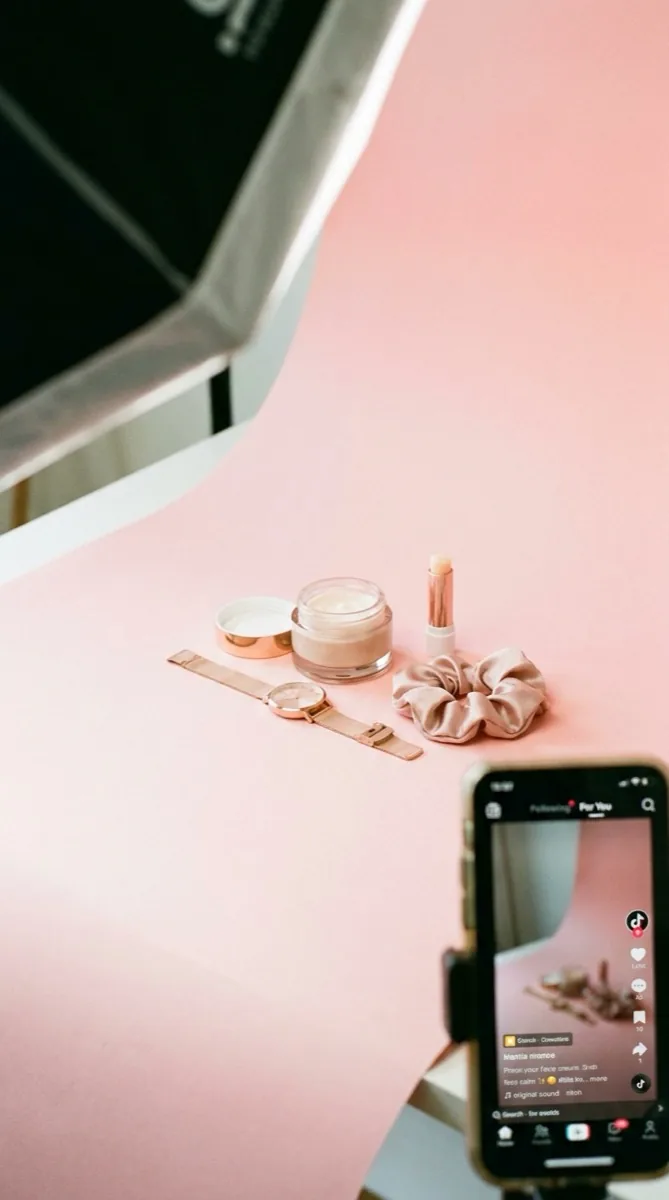
This is the section most UK sellers skip and later regret. Product photography directly controls your listing's algorithmic visibility on TikTok Shop. Listings with fewer than 5 images are automatically rated "Fair" or "Poor" in Seller Centre, and these ratings translate to drastically reduced impressions on the For You Page, in the Shop tab and in creator suggestions. The platform is mobile-native and vertical - your products must look flawless in a 9:16 frame on a 6-inch screen.
Technical specification
- Format: JPG or PNG (WebP also accepted)
- Minimum size: 600x600 px (recommended 1200x1200 px for future-proofing)
- Aspect ratio: 1:1 (square) for the hero image, plus 3:4 (900x1200) for the product card
- Maximum file size: 5 MB per image
- Count: minimum 5, optimal 9 images per product
- Hero image: white or near-white background, product fills at least 80% of the frame, no harsh shadows
- Banned elements: watermarks, logos overlaid on photos, promotional text, price stickers - these trigger automatic listing rejection

Packshot versus lifestyle - what converts on TikTok Shop UK
This is the critical difference from Amazon UK. On TikTok Shop, lifestyle shots convert better than sterile white-background packshots in the gallery positions. TikTok buyers expect authenticity - they want to see the product in use, in a human hand, on a person, in a real environment. A lipstick on a dressing table, a skincare tube being applied, a gadget in a bedroom, not in a laboratory.
However, the hero image (position 1) must still be a clean, light-background packshot - the algorithm specifically rewards this. The optimal nine-image set is: 1 professional packshot (hero) + 4-5 lifestyle shots + 1 macro detail + 1 size comparison (hand, coin) + 1 packaging shot + 1 unboxing/before-after. Every image should tell a different part of the product story.
Why AI cannot replace professional base photography
TikTok Shop UK requires a minimum of 5 images per product - five times more than a basic Amazon listing. For a catalogue of 50 SKUs that is 250-450 images. Generative AI tools can help you swap backgrounds, extend frames or adapt crops for vertical formats, but AI cannot fix bad lighting or rescue a blurred product. AI is post-production, not a replacement for photography.
A strong base image is the foundation on which you build your entire visual system - packshots, lifestyle shots, shoppable video thumbnails, live stream backdrops, affiliate creator briefs. Investment in a professional studio session pays back dozens of times because one clean base set generates variants for every platform (TikTok Shop, Amazon, Instagram, your own Shopify store). The TikTok algorithm prioritises visually compelling listings - poor packshots are filtered out by the algorithm within the first week and rarely recover their ranking. If you are scaling a UK TikTok Shop operation in 2026, contact marszalstudio - we specialise in product photography briefs that meet the platform's exact requirements.
Shoppable videos - format and strategy
Photos are the foundation, but video is the fuel of TikTok Shop. Users who watch a product video are 1.5x more likely to buy than users who see photos alone. And shoppable video - a clip with product tags embedded - is the single format that consistently generates the highest organic reach in the algorithm. If you are not publishing 3 to 5 shoppable videos per week, you are leaving most of your revenue unclaimed.
Technical specification for video
- Format: MP4 or MOV
- Resolution: 1080x1920 px (9:16 vertical)
- Codec: H.264 video + AAC audio
- Optimal length: 15-60 seconds (7-15 seconds for hook-led clips, 30-60 seconds for demos)
- Maximum file size: 500 MB (shoppable post), 5 MB (product card video)
- Target cadence: minimum 3-5 shoppable videos per week for reliable algorithmic visibility
- Captions: always burn in on-screen text - 85% of TikTok views are with sound off for the first 3 seconds
Shoppable videos embed direct product links inside the clip. The formats that consistently convert are usage demonstrations, unboxings, tutorials and before/after comparisons. The vertical 9:16 format is non-negotiable - horizontal 16:9 clips from Instagram or YouTube get cropped badly and perform poorly. Film for TikTok specifically. If you repurpose, do it in a dedicated editing session with proper vertical reframing, not by uploading a horizontal export with black bars.
The shoppable video formats that convert best in 2026
- Usage demonstrations: product in action, 15-30 seconds, zero preamble - hook in the first 2 seconds
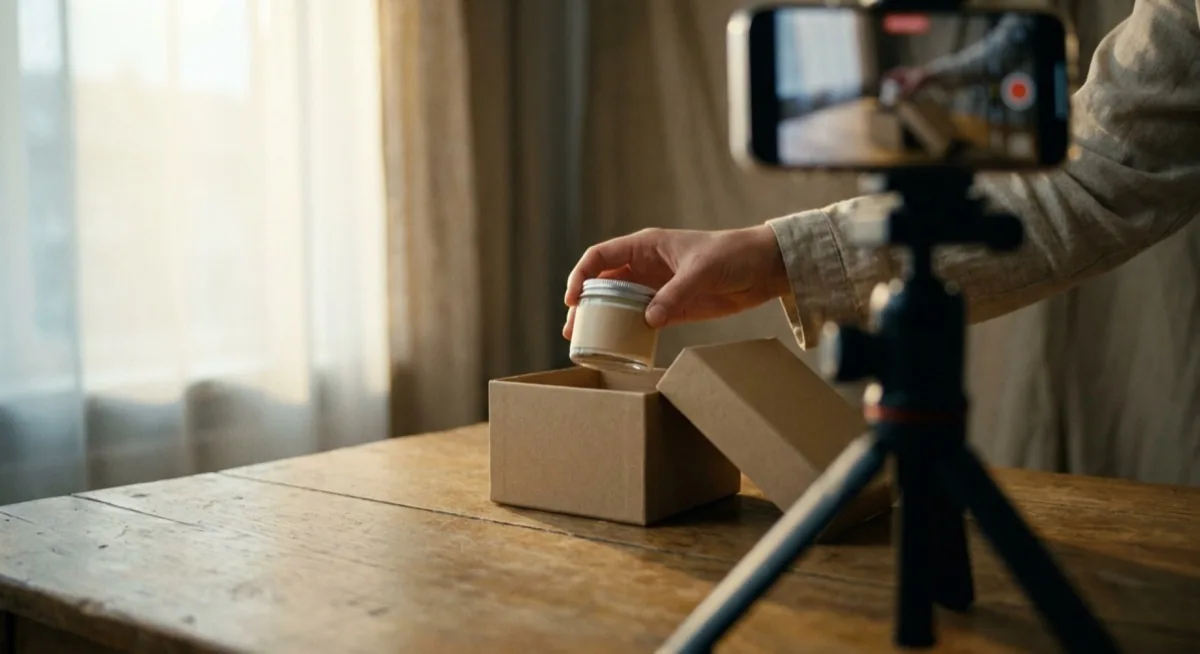
- Unboxings: classic TikTok format, viewers love them. Show the outer packaging, unwrap, reveal the product
- Tutorials: "how to use X", "3 ways to do Y" - educational value with the product as the implicit hero
- Before/after: the result the product produces, especially powerful for beauty, tools, cleaning and fitness
- Behind the scenes: how the product is made, packing orders, studio tours - authenticity is currency on TikTok
- Replies to comments: repurposing questions from live sessions as standalone shoppable videos - the algorithm loves this loop
- POV and "get ready with me": native TikTok storytelling formats adapted for a product moment
Live Shopping playbook - from zero to £1M
TikTok Live Shopping is the feature that separates the platform from every other UK marketplace. Live sales streams generate around 30% of all e-commerce in China and are reshaping the UK beauty and fashion categories. Well-run UK live sessions consistently achieve conversion rates of 10-15%, several multiples of static listings. And Made by Mitchell has proven that a single well-planned live event can generate £800,000+ in revenue in a single 12-hour session.
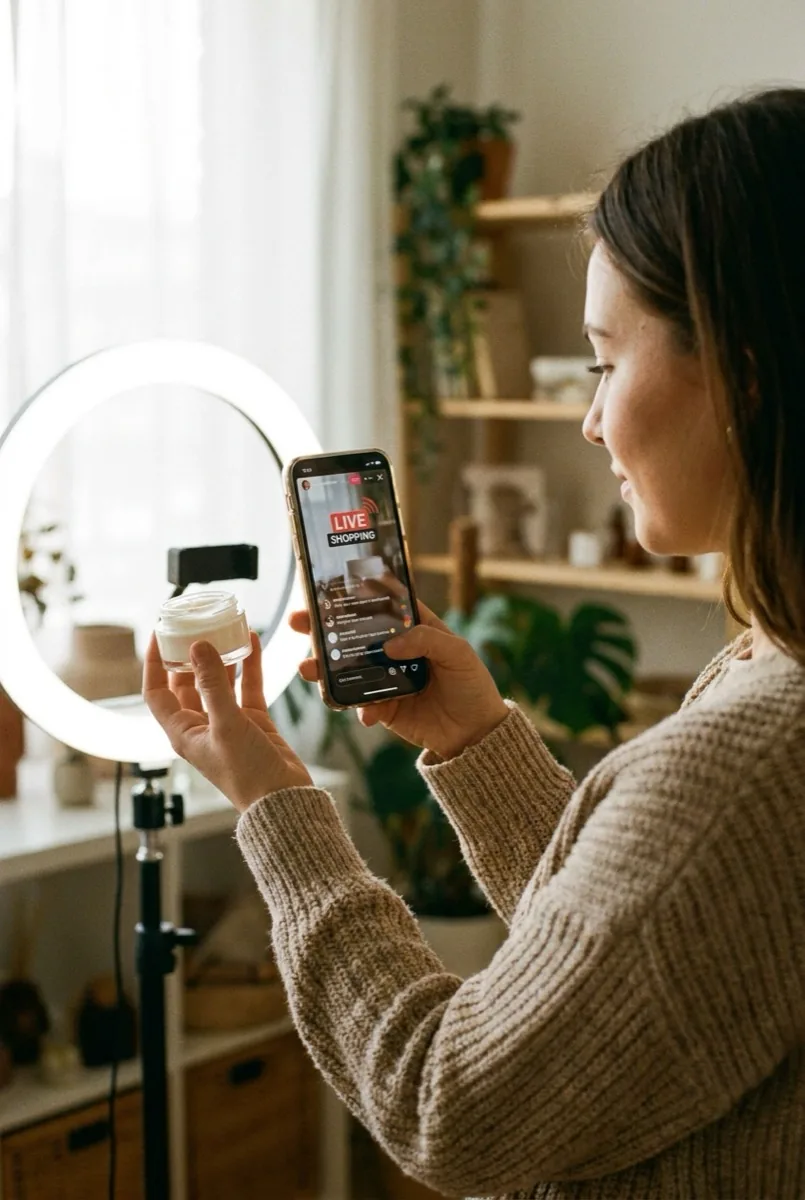
Live shopping technical requirements
- Minimum 1,000 followers on the TikTok account (the threshold that unlocks live)
- Active and verified TikTok Shop seller account
- Products added to the catalogue in advance (you pin them during the live)
- Stable internet connection, minimum 10 Mbps upload (wired connection preferred over Wi-Fi)
- Smartphone capable of 1080p+ or a camera with native 9:16 output (NearStream VM20, Sony ZV, iPhone 14+)
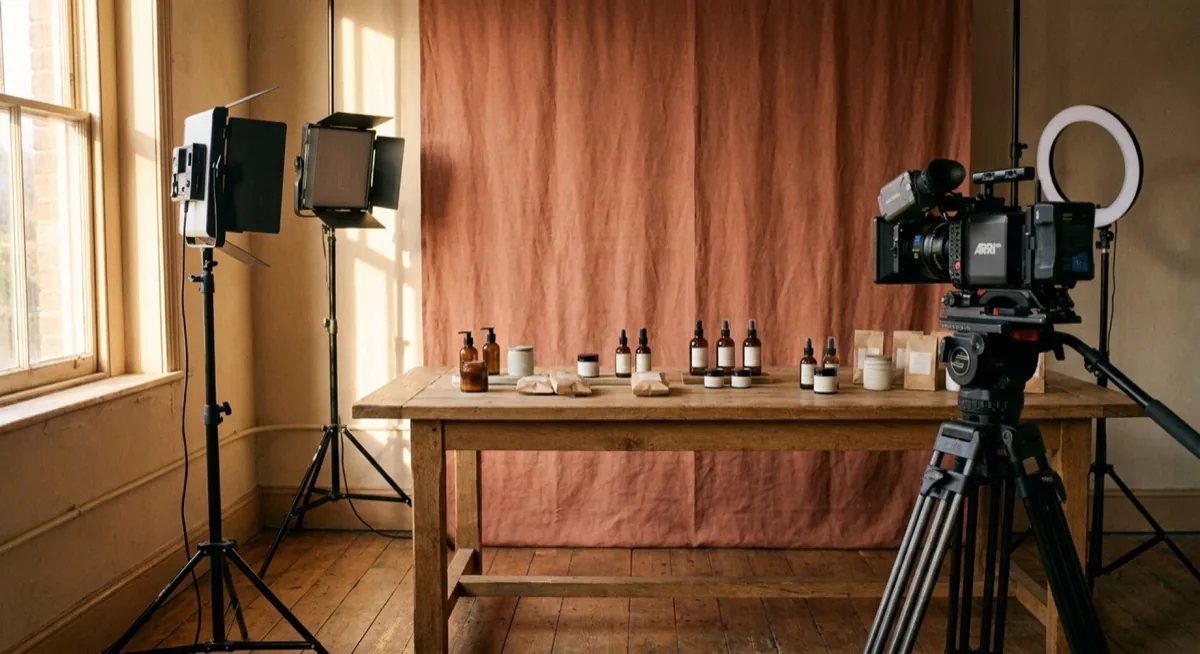
- Proper lighting - ring light at minimum, two-point softbox preferred
Live studio kit and realistic budget
- Camera: 1080p+ smartphone (iPhone 14+ or flagship Android) - use what you have, upgrade later
- Lighting: ring light with diffusion (£40-80) + LED panel for fill (£60-150)
- Microphone: directional or lavalier mic to isolate voice from background (£30-100)
- Tripod/mount: stable, height-adjustable, with a phone holder (£20-60)
- Background: clean but not boring - branded if possible (logo board, coloured curtain)
- Preparation time: budget 30-60 minutes before every session (lighting check, products ready, internet test)
- Starter kit budget: £150-400 for a solid home live shopping setup
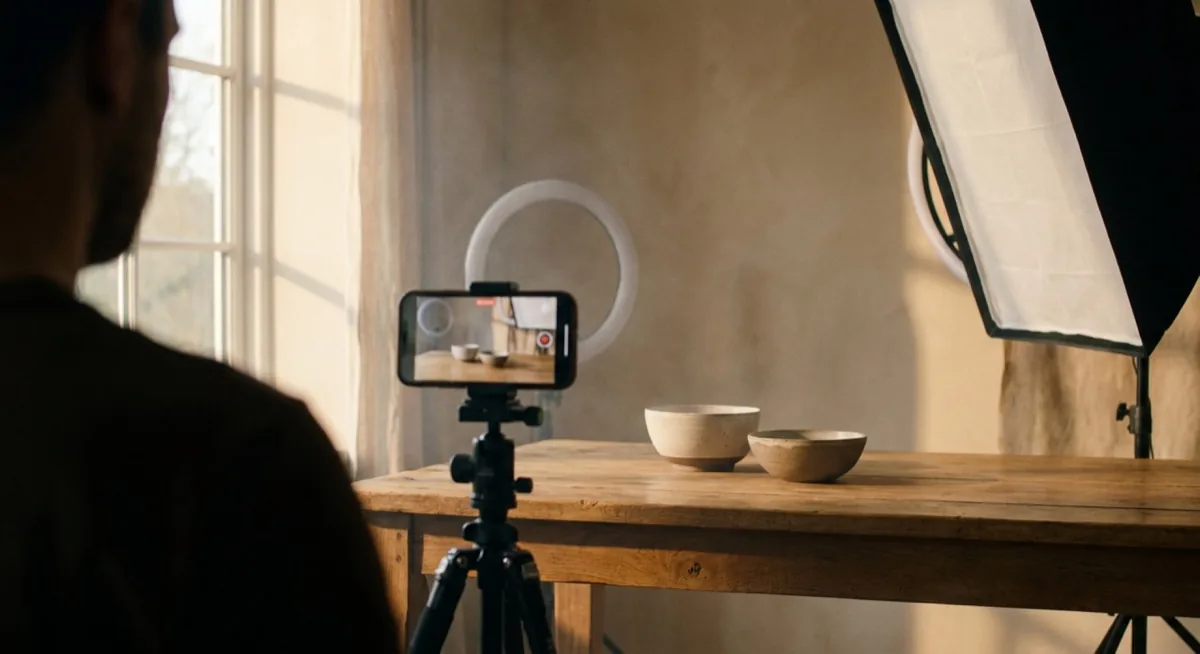
You do not need a television studio. A corner of a room, a clean background and proper lighting are enough to start. A well-lit product photography setup doubles as a live shopping studio for most beauty, fashion accessory and homeware sellers.
The live selling playbook - what actually works in 2026
Forget the QVC shopping-channel formula. TikTok Live is a conversation, not a presentation. You answer comments in real time, show the product from multiple angles, run "how does this work" demonstrations and react to requests from the chat. Viewers buy from sellers they like and trust. It is not performance - it is a meeting with a customer. The moment you sound rehearsed, the conversion drops.
- Duration: 1-3 hours (longer sessions get higher organic reach, the algorithm rewards persistence)
- Product rotation: 6-10 products per hour, pin the active product as you present it
- UK peak hours: 19:00-22:00 GMT weekdays, 11:00-14:00 and 19:00-22:00 weekends
- Frequency: minimum 3x per week to build a regular audience, ideally at a consistent time slot
- Flash deals: time-limited discounts during the live - the classic urgency mechanic that drives real-time conversions
- Promo codes: unique code for live viewers only, entered at checkout - creates FOMO and traceable revenue
- Post-live review: GMV, average watch time, conversion per product, comment questions (raw material for future videos)
Made by Mitchell - the UK playbook case study
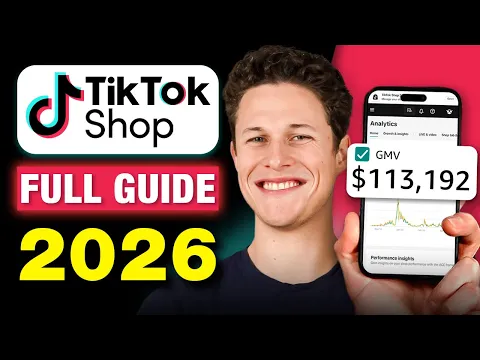
This is the story every UK TikTok Shop operator should study. Made by Mitchell, a British cosmetics brand founded by Mitchell Halliday, generated $1 million in revenue in a single 24-hour period on TikTok Shop UK in June 2024. During a 12-hour Summer Sale live stream they sold one product every second, hitting $830,000 from the live alone before organic sales carried the remainder past seven figures.
Since June 2023, Made by Mitchell has gone live every single day, for a minimum of 6 hours. The result: annual TikTok Shop revenue exceeding £40 million in 2024. The brand now sits in Boots, one of the biggest UK drugstore chains, and Halliday has become an ambassador for TikTok UK's Creator Awards. A two-person brand at launch, now a multi-million-pound operation built almost entirely on one platform.
The three lessons that generalise to every UK seller: consistency beats intensity. A daily 6-hour live is worth more than an occasional 20-hour marathon. The TikTok algorithm rewards consistency above almost anything else. Second, the founder is the brand. Mitchell is the face - customers buy from him, not from an anonymous shopfront. Third, flash deals and urgency mechanics. Time-limited offers and stock countdowns are what convert scroll-level attention into checkout clicks during a live.
The TikTok Shop algorithm and Seller Score
The TikTok Shop algorithm is the fusion of two systems: the content recommendation algorithm (For You Page) and the commerce algorithm (Shop tab and product cards). To sell effectively in 2026 you must understand both. The content algorithm decides which videos appear in a user's feed. The commerce algorithm decides which products win the impressions - and CTR, conversion rate and Seller Score are the three signals that matter most.
What the commerce algorithm actually looks at
- Seller Score - a composite rating driven by dispatch on-time rate, buyer reviews, return rate, and response time to enquiries. Target above 4.5 out of 5, below 4.0 means your impressions collapse
- Listing CTR - how many users click the product after seeing it in the feed or Shop tab. Driven mainly by the hero image and title. Strong average: 3-5%. Top 1% of UK sellers: 8%+
- Conversion rate - percentage of listing visits that end in a purchase. Optimise with price, description, image count, social proof and Q&A
- GMV growth - rising revenue is rewarded with more visibility, falling revenue is punished. Momentum compounds
- Video coverage - products tagged in videos drive traffic to the listing and generate the "popular product" signal the algorithm uses for boosted surfacing
- Live frequency - shops that broadcast regularly receive a visibility boost across all their listings, not only during the live itself
- Creator coverage - the number and quality of creators linking to your products through Creator Connect is now a first-class algorithmic signal
The 90-day UK seller strategy
Focus on 5-10 hero products rather than scattering effort across your entire catalogue. The algorithm needs per-product data to promote a SKU - spreading traffic across 100 SKUs means none hits critical mass. A hero product is one with strong margin, clear USP and high visual content potential. Pick them, defend them and feed them content.
- Days 1-30: record minimum 3 videos per week tagging your hero products. Go live at least once a week. In the first month do not worry about profit - you are building Seller Score and algorithmic history. The algorithm rewards visible activity above all else in this window.
- Days 31-60: actively recruit creators into your Creator Connect plan (10-20% commission for beauty and fashion). Test 2-3 variants of the hero image per top product. Scale live cadence from 1 to 3 sessions per week. Start layering in TikTok Shop Ads (Video Shopping Ads) on your best-performing organic videos.
- Days 61-90: ruthless data analysis - which SKU, which format, which time slot. Cut non-performing SKUs. Scale what works: bigger affiliate budget for top creators, longer live sessions on winning products, new shoppable videos in proven formats. This is the phase where a profitable UK TikTok Shop operation takes shape.

TikTok Shop Creator Connect affiliate programme
Creator Connect is the TikTok Shop affiliate system that lets sellers partner with creators at scale. You set a commission rate, creators select your products from the affiliate marketplace, they promote those products in their videos and live streams, and every sale pays them automatically. It is brutally efficient - Made by Mitchell has publicly stated that around 60% of their TikTok Shop revenue comes from creator affiliates, not from their own videos.
Open Plan versus Targeted Plan
TikTok offers two plan types inside Creator Connect. The Open Plan is a public commission rate available to all creators - anyone can pick your product from the affiliate marketplace and start promoting without any direct relationship. The Targeted Plan is a higher, custom commission for specific creators in your niche - typically the top 50 to 200 creators who can move serious volume in your category.
The strategy that works: start with Open Plan at 10-15% (fast reach, low friction), identify the top performing creators after 30-60 days, then invite them to a Targeted Plan at a higher rate (15-25%) with exclusivity clauses on seeding. This converts passive creator traffic into a controlled, high-performance partner roster. Brands that run Targeted Plans correctly see 3-5x the revenue of brands running Open Plan alone.
Affiliate commission benchmarks by category
| Category | Typical affiliate commission (UK 2026) |
|---|---|
| Beauty and skincare | 10-20% |
| Fashion and accessories | 10-15% |
| Health and wellness | 8-15% |
| Home and garden | 5-10% |
| Consumer electronics | 2-8% |
| Toys and games | 10-15% |
The practical rule: start at 15% commission to build a creator roster quickly, then gradually compress to 10% or 8% as your brand becomes recognisable. Higher commissions create bigger creator motivation, which produces more content, which feeds the algorithm, which drives your organic listings. Micro-influencers (5,000 to 50,000 followers) typically deliver better ROAS than macro celebrities on TikTok Shop UK - they have tighter niches, more engaged audiences and their content feels native rather than advertorial.
One additional mechanic worth mastering: product seeding. Send your product free of charge to 50-100 mid-tier UK creators in your category every month. Even if only 10% of them create content, that is 5-10 new organic videos tagging your products - a multiplier no paid campaign can match. Budget £500-£1,500 a month for seeding across beauty, fashion or wellness.
Logistics and Fulfilled by TikTok (FBT UK)
TikTok operates its own logistics network in the UK. Fulfilled by TikTok (FBT) is functionally equivalent to Amazon FBA - you send your products to a TikTok-operated warehouse (or a partner 3PL), and the platform handles picking, packing, last-mile delivery and returns. FBT has active warehouses in the UK Midlands and South East as of 2026, with same-day pick for orders placed before 2pm.
FBT UK costs and conditions
- Per-unit cost: from £2.80, dropping to approximately £2.20 per unit when 4+ items ship in the same order
- Storage: first 90 days free, then a monthly charge per cubic metre (roughly £18-25 depending on warehouse)
- Carrier integration: Royal Mail Tracked 24/48, Evri, DPD, Yodel - TikTok selects the optimal carrier automatically
- Returns processing: included in the FBT fee, TikTok inspects the returned item and either restocks or disposes
- Delivery promise: 1-2 days within the UK mainland, 2-4 days to the islands and Northern Ireland
- Lead time for inbound: 3-5 working days from receipt at the warehouse to availability for sale
FBT versus Shipped by Seller - the decision matrix
The alternative to FBT is Shipped by Seller - you run your own warehouse or use a 3PL like Huboo, James and James or Prime Fulfilment. If you already have a fulfilment operation for Amazon FBA or Shopify, you probably extend it to TikTok Shop. The trade-off is control versus convenience. FBT is simpler and faster to scale, but you lose customer branding opportunities (inserts, packaging) and pay a premium.
The decision framework most UK sellers use: FBT for under 500 orders a month (simplicity wins), own fulfilment or 3PL for 500-5,000 orders a month (margin wins), hybrid for larger operations with FBT for fast movers and 3PL for long-tail SKUs. If you are running a beauty brand doing £50k+/month through TikTok, a hybrid usually shaves 4-6 percentage points off total fulfilment cost.
Best-selling categories in the UK - beauty, fashion, wellness
Not every product works on TikTok Shop UK. Five years of UK data makes this unambiguous. Here are the categories that consistently generate the highest GMV in 2026 - and the characteristics that define a winning product in each.
- Beauty and Personal Care - 22.5%+ of total UK GMV (the undisputed leader). Colour cosmetics, skincare, haircare, fragrance, beauty tools. Winners: P.Louise, Made by Mitchell, Hair Syrup, Beauty Works
- Womenswear and lingerie - 12.5%+ of GMV. Fast fashion, statement details, size-inclusive ranges. Winners: Oh Polly, ISAWITFIRST, small-batch independent labels
- Health and Wellness - supplements, functional foods, fitness accessories. Regulated but high-margin when compliance is clean
- Consumer electronics accessories - cases, power banks, headphones, chargers. High volume, thin margins, FBT-dependent
- Home decor and homeware - organisers, candles, textiles, small furniture. Strong crossover with lifestyle creators
- Fashion accessories - jewellery, sunglasses, bags, belts. Visual-first, impulse-friendly
- Food and drink - growing fast in 2026, particularly healthy snacks, plant-based, speciality foods
The pricing sweet spot is £15-£30 - products in this range convert best because they fit the impulse-purchase pattern. Above £50 the decision becomes considered and you lose the magic of the swipe-to-buy moment. Below £8 the combined cost of shipping, platform fees and creator commission eats your margin. Design your price architecture around this band and your unit economics stay healthy.
One uniquely British signal worth noting: the "British-made" narrative sells exceptionally well on TikTok Shop UK. Hair Syrup built a £6.5m business partly on its "handmade in Yorkshire" story. The same is true for skincare, ceramics, homeware and fashion. UK buyers - particularly post-Brexit - have become noticeably more positive about domestically produced goods, and TikTok is the perfect medium for that story because the founder can be on camera explaining it.

Case studies - what works on TikTok Shop in UK, USA and Germany
The best predictor of what will work is what already worked. Here are five case studies from TikTok Shop markets, each representing a different category, business model and scale. Every one contains a lesson that generalises directly to UK sellers planning 2026 and 2027.
Handmade cosmetics, UK - £340k in 12 months
A two-person UK operation making natural soaps and skincare. Joined TikTok Shop UK in the launch month of the public opening (2022). After 12 months: £340,000 revenue, 65% from live selling, 35% from organic listings. The unlock: regular lives 4x per week, a strong story about locally sourced ingredients, and the founders visibly on camera explaining every batch.
Lesson for UK sellers in 2026: handmade beauty is still one of the cleanest starting categories. Low entry barrier, high margin, authentic narrative, easy creator seeding. The UK natural-cosmetics scene has genuine depth, and TikTok is the optimal discovery channel for it.
Streetwear reselling, USA - $85k/month after 6 months
A solo operator reselling branded sneakers. Started with $2,000 in product inventory. After 6 months: $85,000 monthly GMV. The method: unboxing content twice daily, lives on weekends, aggressive use of the TikTok Affiliate programme (inviting micro-influencers to promote every drop). Listing CTR 8.3% - roughly four times the category average.
Lesson for UK sellers: reselling branded goods with a tight niche focus (streetwear, vintage, collectibles) works exceptionally well on TikTok. The formula: systematic content + aggressive creator layering. The UK vintage and sneaker scene is deep enough to support multiple independent operators at this scale.
Electronics accessories, Germany - €120k in 3 months
A German importer of smartphone accessories (cases, power banks, chargers). The DE market opened in March 2025. After 3 months: €120,000 revenue. The secret: aggressive pricing (Chinese manufacturing, large orders), fast fulfilment (domestic warehouse), and systematic A/B testing of hero images - 3-4 variants tested per product every week, retaining the best converter.
Lesson for UK sellers: consumer electronics is a volume game with thin margins. The levers are FBT (fast fulfilment), hero image A/B testing and creator relationships for high-volume flash deals. UK sellers competing in this space need rigorous unit economics from day one.
Hair Syrup, UK - £6.5m annual revenue
Natural hair oils founded during lockdown by Lucy Bennett. Joined TikTok Shop UK in 2023, and within 18 months reached £6.5 million annual revenue predominantly from the platform. The model: consistent educational tutorials (how to apply oil, before/after at 2/4/8 weeks), active creator affiliate programme, UK-based manufacturing as a core narrative pillar.
Lesson for UK sellers: educational content (tutorials, before/after, science-led explanations) compounds into trust and sustained conversion. Functional cosmetics with a clear benefit + UK manufacturing + founder narrative = a scalable recipe that works for skincare, haircare, supplements and fitness.
Luxe Collective, UK - 26% of total revenue from TikTok Shop in 3 months
A luxury resale operation (Chanel, Louis Vuitton, Hermès) founded by Ben Gallagher. Established as an online boutique since 2019, but TikTok Shop gave them access to a completely new buyer demographic. Within 3 months on the platform, 26% of total company revenue was coming from TikTok Shop. The model: live shopping with authentic product presentations (Ben as the face of the brand), rigorous authenticity verification, storytelling about each piece's provenance.
Lesson for UK sellers: luxury and high-ticket items can sell on TikTok Shop, but only when you build trust through radical authenticity and transparency. The formula works for jewellery, designer furniture, collectibles, art. The ticket size is higher, the volume lower, but the margin is excellent and the brand-building effect compounds.
The common denominator across all five cases: early entry relative to the competition, aggressive content cadence (minimum 3-4 posts per week), fast logistics, a visible founder as the face of the brand. Not product, not advertising budget - consistency, authenticity and speed. These are variables every UK seller controls regardless of what they sell.
7-step checklist for UK sellers in 2026
If you are starting or optimising a UK TikTok Shop operation in 2026, these are the seven actions that separate operators who scale from operators who stall. Each is specific, testable and required - not optional.
1. Audit your TikTok presence and build community before you sell
Post a minimum of 3 videos per week on the brand account. Build organic reach before activating commerce features - the algorithm rewards accounts with consistent posting history more than accounts with a cold start. Target: at least 1,000 followers (the live threshold) before your first paid acquisition effort. Align your TikTok handle with your shop name and write a sharp bio: "British beauty brand - live drops every Thursday at 8pm GMT".
2. Prepare the visual catalogue (5-9 photos per product)
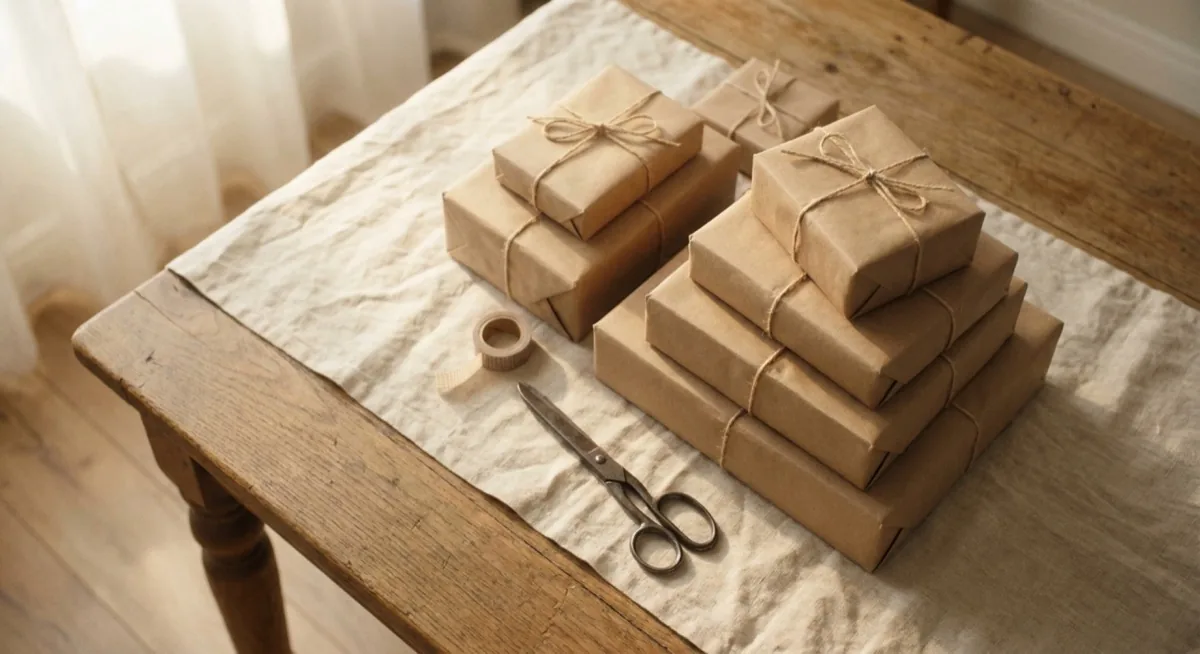
This is where most sellers collapse. 5-9 professional photos for every product - packshot on white background, lifestyle shots, macro details, size comparison, packaging, product in use. A 50-SKU catalogue needs 250-450 images. Plan the shoot in advance - realistic timeline is 2-4 shooting days plus a week of post-production. If you do not have in-house capability, commission a professional studio session now, not after the first listing rejection.
3. Produce the first shoppable videos
Target: 3-5 shoppable videos per week, each 15-60 seconds, vertical 9:16. Usage demonstrations, unboxings, before/after comparisons. They do not need to be perfect - authenticity on TikTok outperforms production value. Start building a library now. By the time you hit your first £10k month you want at least 50 published shoppable videos in your archive so that each hero product has 5-10 videos driving traffic.
4. Configure logistics - FBT, 3PL or own warehouse
Decide early. Fulfilled by TikTok (FBT UK) handles warehousing, picking, packing and delivery. Premium cost, minimum operational overhead - ideal for sub-500 orders a month. Alternative: a UK 3PL (Huboo, James and James, Prime Fulfilment) for mid-volume operations. Whatever you choose, monitor dispatch-on-time obsessively - below 95% your Seller Score suffers.
5. Set your pricing strategy
The sweet spot is £15-£30 retail. Build in the 9% referral fee, payment processing, affiliate commission (5-20%) and fulfilment - target minimum 25% net margin after everything. For beauty and fashion, this typically requires a cost-of-goods ratio of 20-25% against retail, which means you need strong supplier relationships or in-house production from day one.
6. Plan the affiliate budget and seeding programme
Start with 15% commission in Creator Connect Open Plan. Identify and invite top 20-50 micro-influencers (5k-50k followers) in your category to a Targeted Plan at 20%. Budget £500-£1,500 per month for product seeding (free products sent to creators with no commitment). This is the single highest-leverage spend in TikTok Shop UK - higher than any paid-ads allocation.
7. Invest in live shopping kit and cadence
Minimum setup: ring light, directional microphone, phone tripod, clean backdrop. Starter kit budget £150-£400. You do not need a TV studio - a corner of a room with proper lighting is enough to start. Then commit to 3 lives per week minimum, ideally the same time slot every week. Regular UK peak is Tuesday and Thursday 19:00-22:00 GMT. The algorithm punishes inconsistent schedules harder than low-quality output.
FAQ - the 12 questions every UK seller asks
Go to seller.tiktok.com and select United Kingdom as your selling region. You will need either a Companies House registration number (for Limited Companies) or a HMRC UTR (for sole traders), plus a director's or sole trader's passport or UK driving licence, a UK business bank account, and a recent utility bill for address verification. If you are VAT-registered (turnover above £90,000) provide your VAT number. The verification process typically takes 1-3 working days. The TikTok Shop Seller Centre URL is the single official entry point - avoid third-party "registration services" that charge for this free process.
The official TikTok Shop Seller Centre login URL for UK sellers is seller.tiktok.com. Use the email or TikTok account you registered with. If you lose access, the recovery flow runs through the email address linked to the shop - keep that email secure with two-factor authentication. For UK-specific merchant support, the Seller Centre has a dedicated UK help centre reachable from the bottom-right help icon once logged in.
The platform referral fee is 9% for most categories (beauty, fashion, home, wellness), with exceptions for consumer electronics accessories (3-5%) and food/supplements (9-10%). New sellers benefit from a 3% promotional rate for the first 30 days. Payment processing adds approximately 1.02%. Combined effective fee: 9-12% depending on category. There is no monthly subscription or listing fee - you only pay when you sell. If you use Creator Connect affiliate programme add 5-20% for creator commissions. FBT fulfilment costs around £2.20-£2.80 per unit.
As a seller you can issue two types of promo codes from Seller Centre: shop-wide codes (applied at checkout for any product in your store) and product-specific codes (limited to particular SKUs). Buyers enter the code at the checkout screen and see the discount applied instantly. The most effective use of promo codes on TikTok Shop UK is during live sessions - a unique live-only code creates FOMO, drives real-time conversions and gives you a clean attribution trail. Typical TikTok Shop promo code structures: LIVE10 for 10% off during lives, NEW15 for first-time buyers, and bundle codes like BUY2GET1 for cross-sell.
Four requirements: (1) a registered UK business (Limited Company or sole trader with a UTR), (2) a UK business bank account, (3) products that comply with UK safety regulations (UKCA for electricals, CPSR for cosmetics), (4) a catalogue of 5-9 photos per product. Start with 5-10 hero SKUs rather than your entire catalogue, produce 3-5 shoppable videos per week, recruit creators through Creator Connect at 15% commission, and go live at least twice a week. Expect 60-90 days to reach consistent daily sales. The UK market is mature in 2026 so execution quality matters more than timing.
Individual sellers (sole traders): passport or UK driving licence (front and back), HMRC UTR number, UK business bank account IBAN. Corporate sellers: Certificate of Incorporation from Companies House, company UTR, director's ID, company bank account, recent utility bill. For cosmetics, electricals, supplements or toys, additional product certifications are needed (CPSR+PIF+Responsible Person for cosmetics, UKCA for electricals, MHRA for supplements, EN71 for toys). Rejection rates are high for blurry scans, name mismatches between bank and Companies House, or missing director address proof. Use 300 DPI PDF scans, not smartphone photos.
No - you do not need any followers to upload products to the catalogue. You need at least 1,000 followers to unlock live shopping. You can create videos tagging your products with any follower count. The seller account is a distinct profile from a creator account. The TikTok algorithm can promote accounts with near-zero followers if the content is strong - small UK sellers with 500 followers routinely outperform 50,000-follower accounts with weak content. Quality of output beats size of audience on TikTok Shop.
Neither is strictly "better" - they serve different purposes. Amazon UK is search-first with high-intent buyers and stable, predictable volume. TikTok Shop UK is content-first with impulse buyers, virality potential and brand-building value. Amazon requires strong product listing SEO and paid ads. TikTok Shop requires video content, live shopping and creator partnerships. The strongest UK sellers run both: Amazon as the revenue anchor, TikTok Shop as the growth engine. For beauty, fashion accessories and wellness brands, TikTok Shop often overtakes Amazon in revenue within 12-18 months of consistent execution.
You need (1) minimum 1,000 followers on your TikTok account, (2) an active and verified TikTok Shop seller account, and (3) equipment: a 1080p+ smartphone, a ring light, a directional microphone, a tripod. Optimal session length is 1-3 hours, pinning 6-10 products per hour. UK peak hours are 19:00-22:00 GMT weekdays and 11:00-14:00 plus 19:00-22:00 at weekends. The key to success is consistency - broadcast at the same time slot, minimum 3x per week. Starter kit costs £150-£400. Most UK sellers break into profitable live sessions within 6-8 weeks of consistent broadcasting.
FBT UK is TikTok's equivalent of Amazon FBA - you send inventory to a TikTok-operated warehouse (Midlands or South East hubs), and TikTok handles picking, packing, delivery and returns. Per-unit cost starts at £2.80, dropping to ~£2.20 at 4+ units per order. First 90 days of storage are free, then per-cubic-metre charges apply. Use FBT if you ship fewer than 500 orders per month and want operational simplicity. For higher volumes, a UK 3PL (Huboo, James and James) typically saves 4-6 percentage points. Delivery promise under FBT is 1-2 days to mainland UK - critical for Seller Score above 4.5.
Globally and in the UK, beauty and personal care dominates (22.5%+ of GMV), followed by womenswear and lingerie (12.5%), health and wellness supplements, consumer electronics accessories, and homeware. The UK-specific signal is that products with a "British-made" or "Yorkshire-made" narrative consistently outperform generic imports - Hair Syrup, P.Louise and many independent brands have built on this pattern. The pricing sweet spot is £15-£30 retail. Above £50 the impulse model breaks down. Visual-first products with a clear "wow moment" on camera (colour cosmetics, fashion with distinctive details, gadgets with visible results) consistently convert best.
Technically yes, practically very difficult. TikTok Shop UK enforces strict delivery time requirements (maximum 15 days, strongly recommended 3-5 days) and product quality standards. Classic AliExpress dropshipping rarely meets either, and Seller Score suffers fast. Viable alternatives: UK-based dropshipping partners (CJ Dropshipping UK warehouse, Spocket UK suppliers), UK 3PL with pre-imported stock, or Fulfilled by TikTok (FBT) with inventory shipped to TikTok's UK warehouse in advance. Any dispatch delay directly reduces Seller Score, which reduces listing visibility, which reduces sales - a spiral that is very hard to reverse once started.
Conclusion - winning the next 12 months on TikTok Shop UK
TikTok Shop UK is no longer a frontier - it is a battlefield. Five years after launch the platform has become one of the most important sales channels in British e-commerce, especially for beauty, fashion and wellness. The early-adopter window is closed. The 2022 merchants who rode the algorithmic boost are now entrenched. For a UK seller in 2026, success is not about timing - it is about execution quality, operational discipline and visual storytelling.
Made by Mitchell proved that £1 million in a single day is a real outcome, not a marketing fantasy. Hair Syrup proved that educational content scales to £6.5 million a year. Luxe Collective proved that even luxury sells through live shopping. What unites them is not budget, product or luck - it is a founder visible on camera, a consistent posting cadence, a disciplined creator roster and a serious commitment to base photography. The same combination is available to any UK seller willing to commit 6-12 months of consistent execution.
You have two choices in front of you. Wait for TikTok Shop to somehow get easier - it will not. Or start today with a precise operational plan: verify your Seller Centre account, produce 5-9 photos for each hero SKU, record 20 shoppable videos, onboard 10 creators into a 15% Creator Connect plan, go live 3 times a week at a fixed time slot, and run the analytics loop weekly. That is the playbook. Everything else is noise.
One thing is certain in 2026: the quality of your product photography directly controls your algorithmic visibility and conversion. AI tools help in post-production but cannot replace a solid base image shot with proper lighting and composition. The TikTok algorithm prioritises visually compelling listings - poor packshots are filtered out within the first week, and recovery is rare. Invest in the foundation - 5-9 images per product, minimum 1200x1200 px, 1:1 for hero and 9:16 for video cover. This is not an option, it is a platform requirement.
Need professional product photography built for TikTok Shop UK? Contact marszalstudio - we produce visual catalogues that meet the platform's exact requirements. 5-9 images per product, packshots and lifestyle, square and vertical formats, ready to upload to Seller Centre. We specialise in product photography that sells - on every platform, in every market.
Questions about TikTok Shop UK? Leave a comment below - we answer every question about selling online and product photography for social commerce.