Smartphone product photography in 2026 is a completely different conversation than it was two years ago. iPhone product photography for UK Etsy and eBay sellers, plus Pixel 10 product photography for Amazon UK packshots, plus Galaxy S26 Ultra product photos for fashion lookbooks - one phone covers all three workflows. The iPhone 17 Pro hit 168 points on DXOMARK Mobile (3rd globally, the best outside Chinese flagships), Galaxy S26 Ultra introduced a 200 MP sensor with f/1.4 aperture (the brightest in smartphone history), and Pixel 10 Pro with Pro Res Zoom AI extends sharp zoom to 100x. The UK market got every model in line with global launches: iPhone 17 Pro 256 GB at £1199 (Apple Store UK, Currys), Pixel 10 Pro at £999, Galaxy S26 Ultra at £1249 (Samsung UK).
Here is something UK guides do not write about: the UK SERP for "best phone for product photos" is 10/10 generic ranking lists - none of them target product photography for e-commerce sellers. That is the open niche we fill below. Plus a warning: the minimum focusing distance on the iPhone 17 Pro tele (~85 cm) is a spec-sheet black hole Apple does not publish, and it realistically blocks the model for jewellery packshots and micro-detail. Galaxy S26 Ultra has a similar problem, while Pixel 10 Pro is the strongest performer in macro thanks to a dedicated Macro mode from Google.
DXOMARK 2026 - flagship smartphone camera ranking
Current DXOMARK Mobile ranking (May 2026):
| Rank | Model | DXOMARK Score | UK price May 2026 | UK availability |
|---|---|---|---|---|
| 1 | Huawei Pura 80 Ultra | 184 | ~£1700 (grey import) | No official UK availability (US sanctions) |
| 2 | Vivo X300 Ultra | 176 | ~£1350 (grey import) | No official UK availability |
| 3 | iPhone 17 Pro / Pro Max | 168 | £1199-£1499 | Full availability (Apple Store UK, Currys, John Lewis) |
| 4 | Xiaomi 15 Ultra | 167 | ~£1100 | Full availability |
| 5 | OPPO Find X9 Pro | 165 | ~£1050 | Partial availability |
| 6 | Pixel 10 Pro | 163 | £999 | Full availability (Google Store UK, Argos, EE) |
| 7 | Galaxy S26 Ultra | 160 | £1249 | Full availability (Samsung UK, Currys, John Lewis) |
| 8 | Samsung Galaxy S25 Ultra | 156 | ~£849 (clearance) | End-of-line |
The 2026 market paradox: Chinese flagships dominate DXOMARK, but they are practically unavailable in the UK and EU due to US sanctions (Huawei) and certification requirements (Vivo, OPPO partly). For UK e-commerce sellers the realistic choice is between iPhone 17 Pro, Pixel 10 Pro and Galaxy S26 Ultra - and each has different strengths.
An interesting community paradox: MKBHD (Marques Brownlee) named OPPO Find X9 Pro Camera of the Year 2025 even though DXOMARK placed it 5th. The reason: MKBHD blind tests rate subjective preference, while DXOMARK measures objective metrics (dynamic range, colour accuracy, noise). Subjective quality matters for content creators, but UK e-commerce sellers need objective data (Colour Delta E, edge sharpness, batch consistency).

iPhone 17 Pro review - 3x48 MP Fusion plus tetraprism

iPhone 17 Pro (launched September 2025) introduced the biggest optical change since the iPhone 11 Pro: all three lenses now use a 48 MP Fusion sensor (24 mm f/1.78 main, 13 mm f/2.2 ultra-wide, 100 mm f/2.8 tele). The tele was redesigned around a tetraprism - the sensor is 56% bigger than on iPhone 16 Pro, giving 4x optical zoom plus 8x crop (up to 32x) without significant quality loss.
- Main camera 48 MP Fusion f/1.78 - 24 mm equiv, 1/1.28" sensor, second-generation Quad-Pixel
- Ultra-wide 48 MP f/2.2 - 13 mm equiv, autofocus down to 2 cm minimum (the only iPhone 17 Pro camera friendly to macro)
- Tele 48 MP f/2.8 tetraprism - 100 mm equiv, 4x optical, 8x crop = 32x maximum, sensor 56% larger vs 16 Pro
- Apple Photonic Engine v3 - completely new ML pipeline, better low-light, fewer noise reduction hallucinations
- ProRAW 14-bit plus Coverage mode (RAW and JPG together) plus Process Zero in the Halide app
- USB-C 3 (10 Gbps) - 20x faster than iPhone 14, key for tethering and ProRAW transfer
Critical drawback for product photography: minimum focus distance (MFD) on the tele is around 85 cm (per onoff.gr report and Lux.camera analysis from March 2026). Apple does not officially publish this, but community testing confirms it - for jewellery packshots (typical shooting distance 20-40 cm) the tele is useless, you have to rely on the ultra-wide with 2 cm autofocus. That means iPhone 17 Pro is NOT the best choice for jewellery and micro-detail, even though overall it has the highest DXOMARK score among phones available in the UK.
Second bug: iOS 26 (released October 2025) has a known "light band" issue on the left side of the tele RAW - Apple promised a fix in iOS 26.2 (planned for June 2026), but right now it affects product photography (a delicate white background shows a faint dark gradient on the left of the frame).

Pixel 10 Pro product photography - Pro Res Zoom AI to 100x

Pixel 10 Pro (launched October 2025) is £200 cheaper than iPhone 17 Pro in the UK and has a unique feature: Pro Res Zoom AI up to 100x (kicks in from 30x). This is AI-augmented zoom that combines classic 5x optical with generative AI fill - the result is around 80% the quality of a true optical 100x, but it works on a small sensor.
- Main camera 50 MP f/1.68 - 25 mm equiv, sensor 1/1.31" (one of the largest in smartphones), light gathering sufficient for studio shoots
- Ultra-wide 48 MP f/1.7 - 12 mm equiv, autofocus down to 2 cm (dedicated Macro Focus mode)
- Tele 48 MP f/2.8 - 5x optical, 30x super res (classic), 100x Pro Res Zoom AI (from 30x)
- Tensor G5 chip - dedicated ML co-processor, 30% faster generation than Pixel 9 Pro
- Magic Eraser, Best Take, Add Me - AI features built in (some paid via Google AI Pro $19.99/month)
- USB-C 3.2 Gen 1 (5 Gbps)
Pixel 10 Pro is the strongest phone for product photos for macro photography in 2026 - ultra-wide with 2 cm autofocus plus a dedicated Macro mode plus AI sharpening = realistically the best jewellery and micro-product packshots among flagship smartphones. Plus 100x Pro Res Zoom AI is unique - though that feature is for travel and wildlife photography, not e-commerce.
Weakness: Pixel 10 Pro uses the same camera modules as Pixel 9 Pro (DXOMARK confirms it). The main change is the new Tensor G5 and AI processing - but the physical pixels are identical. For professionals demanding the latest sensor tech that is a plus for the Pixel 9 Pro (cheaper in 2026 - around £650), but for content creators the value of AI features outweighs the marginal hardware difference.
Galaxy S26 Ultra product photos - 200 MP f/1.4 plus dual tele

Samsung Galaxy S26 Ultra (launched January 2026) is the newest flagship with the brightest aperture in smartphone history - f/1.4 on the 200 MP main camera. That is 32% brighter than f/1.7 on Pixel 10 Pro and 25% brighter than f/1.78 on iPhone 17 Pro, which translates into genuinely better low-light performance without heavy studio lighting.
- Main camera 200 MP f/1.4 - 24 mm equiv, sensor 1/1.3" (Samsung HP3), pixel binning to 12.5 MP for low-light
- Ultra-wide 50 MP f/1.9 - 13 mm equiv, autofocus down to 5 cm
- Tele 1: 50 MP f/2.4 - 70 mm equiv, 3x optical
- Tele 2: 50 MP f/2.9 - 110 mm equiv, 5x optical (combined with digital crop gives 100x maximum)
- Expert RAW - Samsung's own RAW format (better than Apple Pro RAW according to PetaPixel)
- USB-C 3.2 Gen 2 (10 Gbps)
- Galaxy AI features - the full set (Photo Assist, Sketch to Image, Generative Edit) with Samsung Galaxy AI subscription
PetaPixel controversy from April 2026: Galaxy S26 Ultra is "critically sceptical of AI" in Pro modes. The default mode applies aggressive noise reduction in JPEG (Samsung's level is higher than Apple's or Google's), but Expert RAW gives you raw files without that processing. For professionals Expert RAW is genuinely better than Apple Pro RAW - wider dynamic range, less of Samsung's preset "look".
Paradox: Samsung Expert RAW plus DaVinci Resolve colour grading can give UK online stores better quality than iPhone 17 Pro ProRAW plus Apple Photos. There are more post-processing steps though (RAW import, DaVinci, export), which adds 20-30% to working time.
Halide app review - Mark III and the legendary 2026 drama
Halide is the most popular professional photography app for iPhone. 2026 pricing: $9.99/month, $19.99/year (around £9.99/year in UK pricing) or $59.99 lifetime. The team: founders Ben Sandofsky (CEO, ex-Twitter) and Sebastiaan de With (designer, ex-Apple). Mark II shipped in 2019, Mark III preview in January 2026.
The 2026 drama that shook the iOS photography scene:
- September 2025 - acquisition talks for Lux (Halide's parent) by Apple stalled
- January 2026 - de With joined the Apple Design Team, Sandofsky stayed at Lux
- March 2026 - Sandofsky sued de With for $150,000 (allegations: breach of partnership agreement, use of Lux intellectual property at Apple)
- May 2026 - case unresolved, Lux ships Mark III in preview, but development is slower than before
Halide Mark III preview (January 2026) introduces:
- Process Zero II (an extension of Halide 2.15 from August 2024) - adds HDR, Night Mode, ProRAW, tone editing. Philosophy: single-shot, 12 MP DNG, NO AI processing
- Chroma Noir - black-and-white film emulation, developed by colourist Cullen Kelly (from the Apple TV+ team)
- 14-bit XDR zebras - HDR-aware exposure preview
- Coverage mode - RAW and JPG together (full 14-bit RAW plus optional JPG for quick share)
- Smart Mode AI (optional, off by default) - AI auto-exposure for typical scenarios
Halide's philosophy is opposed to Apple Computational Photography: Apple ProRAW includes a computational layer (AI noise reduction, HDR fusion), while Halide Process Zero gives a single-shot 12 MP DNG without AI - a "clean" file from the sensor. For professionals wanting full control in post-processing this is a game changer.
Filmic Pro is dying, Blackmagic Camera is FREE - the future of mobile video

The second 2026 game changer is in mobile video. Filmic Pro (for years the standard for professional mobile filmmaking) is dying in 2026 - after Bending Spoons layoffs (the parent company let go of 80% of the Filmic team in December 2025), the app has not had an update in six months and the community is migrating away.
The successor is Blackmagic Camera, free since late 2024 - and competitively the most powerful in 2026. What you get for free:
- Full manual control - shutter speed, ISO, white balance, focus distance
- Apple ProRes recording (on iPhone 15 Pro and newer) - the professional codec used in post-production
- 3D LUT support - import a custom LUT (e.g. Kodak 2383 emulation), applied on the fly
- Video looks - 16 built-in presets (Cinematic, Documentary, Music Video)
- Direct cloud upload to DaVinci Resolve Cloud (Blackmagic ecosystem)
- Audio meters and scopes - waveform and vectorscope for professional monitoring
Other apps worth considering in 2026:
- Camera+ 2 ($4.99 one-off, no subscription) - a Halide alternative for users who do not want a subscription, manual controls plus RAW
- Kino ($9.99 one-off) - dedicated to filmmaking, simpler UI than Blackmagic
- Moment Pro Camera ($6.99 one-off, Android plus iOS) - the only pro app on both platforms
- ProCamera+ ($19.99/year) - Grey Card Calibration (key for accurate product colour) plus a built-in editor
- Lightroom Camera (Free plus Adobe Photography Plan £9.98/month for full features) - DNG RAW, presets, Lightroom Cloud integration
Mini studio with a smartphone - UK setup for around £450
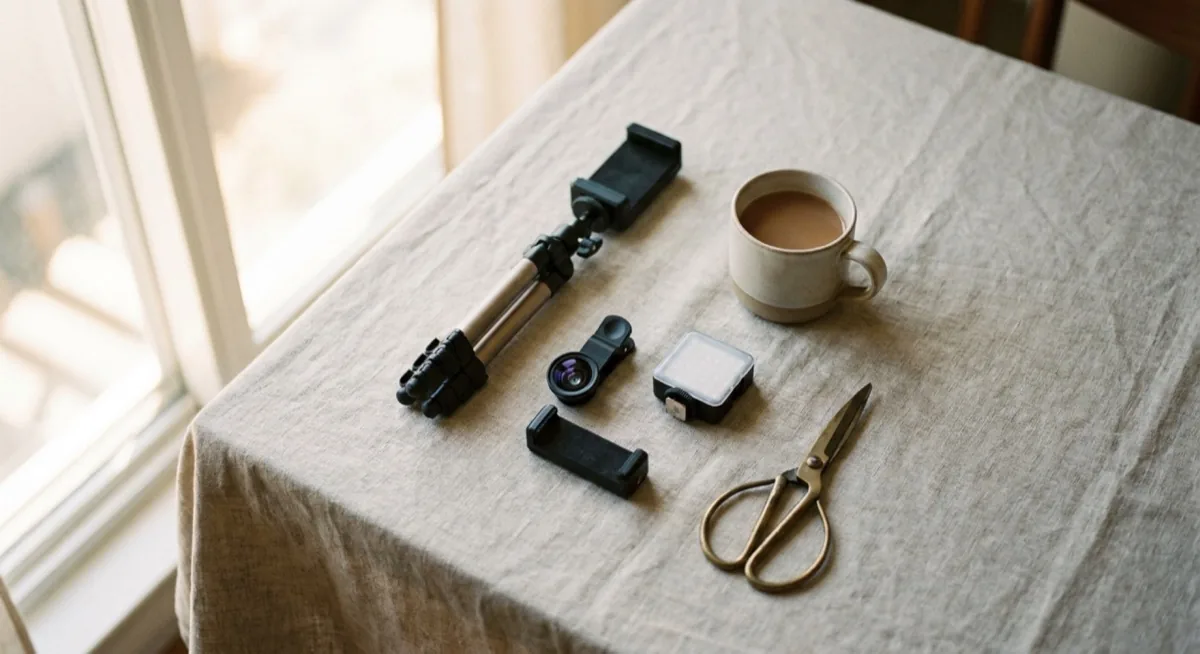
The most common question UK sellers ask: can you make professional packshots with just an iPhone or Pixel? The answer: yes, if you have the right accessories. A minimum mini-studio setup for around £450 (priced at Amazon UK and John Lewis):
- Small lightbox 60x60 cm with LED: Andoer studio box - £75
- Mini tripod with phone holder: SmallRig FreeBlazer Mini - £55 or JOBY GorillaPod Mobile - £45
- Clip-on lens kit: Moment Macro 75mm - £130 (10x optical magnification, key for jewellery)
- SmallRig MagSafe Mount Plate 5155 - £28 (for iPhone Pro)
- White seamless background 1x1 m: 200 g craft paper - £14
- Diffuser white 60x60 cm: PULUZ - £26
- Natural jute string and styling props: £20
- Halide app ($59.99 lifetime) - around £48
Total: around £440, plus the smartphone you already own. Workflow: place the product in the lightbox under LED, smartphone on the tripod, Halide in Process Zero mode for maximum control, ProRAW or DNG export. Quality is typically 70-80% of a classic DSLR studio session, time is 30 minutes instead of 2-3 hours.

Minimum focus distance - the spec-sheet black hole
The most overlooked parameter in smartphone reviews is Minimum Focus Distance (MFD) - the distance at which the camera can lock focus. Manufacturers do not publish it (because it is a weak point vs DSLR), but community testing shows:
| Camera | MFD main | MFD ultra-wide | MFD tele |
|---|---|---|---|
| iPhone 17 Pro main 24mm | ~10 cm | ~2 cm | ~85 cm (black hole) |
| Pixel 10 Pro main 25mm | ~10 cm | ~2 cm (dedicated Macro Focus) | ~80 cm |
| Galaxy S26 Ultra main 24mm | ~12 cm | ~5 cm | ~75 cm tele 1, ~100 cm tele 2 |
| Sony A6400 plus 90mm Macro | n/a (depends on lens) | n/a | 28 cm (1:1 macro) |
The conclusion: no smartphone replaces a full macro DSLR or mirrorless for micro-detail. The iPhone 17 Pro tele 100 mm needs 85 cm of distance, while the Sony FE 90mm Macro handles 28 cm and gives 1:1 magnification. For jewellery, postage stamps, coins and micro-electronics a dedicated camera with a macro lens is an investment you cannot avoid.
For 80% of other products (cosmetics, clothing, homeware) a flagship smartphone with a good lightbox really does replace DSLR or mirrorless. Pixel 10 Pro with its dedicated Macro Focus mode is the strongest in this category - it gives 2 cm MFD on ultra-wide with autofocus and AI sharpening.

iPhone 18 Pro variable aperture - is it worth waiting until September 2026?

Apple is preparing the biggest optical change since the iPhone 7 (launched 2016): iPhone 18 Pro with variable aperture in September 2026. The Mark Gurman Bloomberg leak (February 2026) confirms:
- Main camera variable aperture f/1.4 - f/4.0 - electronic aperture control, like a classic DSLR
- Sensor 48 MP (no resolution change, but a new Sony IMX904 chip with greater dynamic range)
- Dedicated Macro mode on the main camera - autofocus down to 5 cm (vs 10 cm on iPhone 17 Pro)
- Apple Photonic Engine v4 - probably with a new ML model trained for product photography
- Estimated price: $1,099-1,299 (256 GB), in the UK around £1099-£1299
Variable aperture realistically means: you pick f/1.4 for shallow depth of field (blurred background, lifestyle look) or f/4.0 for deep focus (sharp product plus sharp background, documentary packshot). That is a game changer for content marketing - one phone shoots Instagram lifestyle (f/1.4) and Amazon UK packshots (f/4.0) without compromise.
Is it worth waiting? Yes, if you are buying in this price bracket for the first time. The iPhone 17 Pro will see a 15-20% discount after the 18 Pro launch, and 18 Pro adds variable aperture (key for professionals). If you already have an iPhone 14, 15 or 16 Pro - it is worth waiting until September 2026, because the upgrade will be significant. If you are on Android - consider Galaxy S26 Ultra now (it already has f/1.4 as a fixed aperture), or wait for Galaxy S27 Ultra (January 2027) which will probably also add variable aperture.
Tethered mobile - iPad Pro plus Capture One in real life
An underrated 2026 trend: tethered mobile shooting, where an iPhone or Android works as the camera and an iPad Pro or MacBook acts as a live preview monitor. The setup:
- iPhone 17 Pro plus Moment Pro Camera plus USB-C cable plus iPad Pro M4 - live preview on a 13" iPad Pro through Capture One iPad app (available since 2025)
- Pixel 10 Pro plus Lightroom Mobile plus USB-C plus MacBook - real-time photo sync to Lightroom CC, edit on MacBook
- Galaxy S26 Ultra plus Samsung Camera Pro plus USB-C plus tablet - Samsung's official setup for studio photography
Cost of a full mobile studio for a UK content creator: iPhone 17 Pro (£1199) plus iPad Pro M4 11" (£999) plus accessories (£300) = around £2500. A classic DSLR session plus laptop plus softboxes: around £3500-4500. A mobile setup is 25-40% cheaper and significantly more portable - you can shoot at the client's home, on location, or while travelling between London, Manchester and Bristol.
The top three in the UK: iPhone 17 Pro (DXOMARK 168, £1199, best overall but MFD around 85 cm on tele blocks jewellery packshots), Pixel 10 Pro (DXOMARK 163, £999, the strongest for macro thanks to dedicated Macro Focus mode plus Pro Res Zoom AI 100x), Galaxy S26 Ultra (DXOMARK 160, £1249, 200 MP f/1.4 brightest aperture). Chinese flagships (Huawei Pura 80 Ultra 184, Vivo X300 Ultra 176) win DXOMARK but are unavailable in the UK and EU due to US sanctions. For 80% of e-commerce a flagship smartphone plus a 60x60 cm lightbox plus the Halide app delivers 70-80% of a classic DSLR session quality. For jewellery and micro-detail you still need a camera with a macro lens (Sony FE 90mm Macro 28 cm MFD vs 85 cm on iPhone tele).
iPhone 17 Pro 256 GB: £1199 (Apple Store UK, Currys, John Lewis), with carrier deals from O2, EE, Vodafone, Three and Sky Mobile. iPhone 17 Pro Max 256 GB: £1349. The 512 GB Pro is £1399, 1 TB Pro around £1599. For comparison: Pixel 10 Pro 256 GB at £999 (£200 cheaper), Galaxy S26 Ultra 256 GB at £1249 (£50 more). iPhone 17 Pro has the highest DXOMARK score among phones available in the UK (168), but Pixel 10 Pro wins the value ratio - 17% cheaper for just 5 DXOMARK points less. Plus Apple is readying iPhone 18 Pro with variable aperture for September 2026 - if you want the absolute top, it is worth waiting four months.
Yes, for professional iPhone users Halide remains the strongest photo app - $9.99/month, $19.99/year (around £9.99/year UK pricing) or $59.99 lifetime. Mark III preview from January 2026 added Process Zero II (single-shot 12 MP DNG without AI processing - a "clean" file from the sensor, opposing Apple ProRAW), HDR and Night Mode in Process Zero, 14-bit XDR zebras, Coverage mode (RAW and JPG together). The 2026 drama - Sandofsky sued de With for $150k, de With joined the Apple Design Team - may slow development, but Mark III runs stably. A cheaper alternative: Camera+ 2 ($4.99 one-off, no subscription) has similar manual controls plus RAW. If you use iPhone for filmmaking, Blackmagic Camera (FREE) is better than Halide.
Yes, if you are buying in the £1000-£1500 bracket for the first time. Mark Gurman of Bloomberg (February 2026) confirms iPhone 18 Pro with variable aperture f/1.4-f/4.0 will launch in September 2026. That is a game changer for professionals - you choose f/1.4 for shallow depth of field (lifestyle Instagram) or f/4.0 for deep focus (Amazon UK packshot) without compromise. Plus iPhone 17 Pro will see a 15-20% discount after the 18 launch (down to around £950-£1000). If you have iPhone 14, 15 or 16 Pro it is worth waiting until September. If you use Android, Galaxy S26 Ultra already has f/1.4 as fixed aperture (not variable), so it is a real alternative right now. Galaxy S27 Ultra (January 2027) will probably also add variable aperture.
Yes, Pixel 10 Pro (£999) is the strongest for macro photography among 2026 flagship smartphones. It has a dedicated Macro Focus mode (built into the Camera app), autofocus down to 2 cm on the ultra-wide, and Photonic Engine v3 AI sharpening (Tensor G5 chip). Pro Res Zoom AI to 100x is unique but aimed at travel and wildlife photography rather than e-commerce. Weakness: it uses the same camera modules as Pixel 9 Pro (DXOMARK confirms it), the main change is Tensor G5 and AI processing. For professionals demanding the latest sensor it is worth considering Pixel 9 Pro in 2026 (around £750, £200 cheaper for similar hardware). DXOMARK 163 (#6 globally, #2 UK-available behind iPhone 17 Pro 168).
Yes, it is a game changer. Filmic Pro is dying after Bending Spoons layoffs (the parent company let go of 80% of the Filmic team in December 2025), and the app has not had an update for six months. Blackmagic Camera is FREE and has more features than Filmic Pro: full manual control (shutter, ISO, WB, focus), Apple ProRes recording (on iPhone 15 Pro and newer), 3D LUT support (custom LUT applied on the fly), 16 built-in Video Looks, direct cloud upload to DaVinci Resolve Cloud, audio meters and scopes. For professional mobile filmmaking in 2026 it is the new standard. Alternatives: Kino ($9.99 one-off), Camera+ 2 ($4.99 one-off). Blackmagic Camera is the best option for content creators shooting up to 4K video.
The main problem is Minimum Focus Distance (MFD) - the distance at which the camera can lock focus. iPhone 17 Pro tele 100 mm needs around 85 cm minimum, which is 3x further than a classic camera with a macro lens (Sony FE 90mm Macro = 28 cm at 1:1 magnification). For jewellery (typical shooting distance 20-40 cm) the iPhone tele is useless - you have to rely on ultra-wide with 2 cm autofocus, which gives a worse perspective. Pixel 10 Pro is the strongest in this category (dedicated Macro Focus mode plus AI sharpening), but it still does not match DSLR or mirrorless. For 80% of other products (cosmetics, clothing, homeware) a flagship smartphone plus a 60x60 lightbox delivers 70-80% of a classic DSLR session. For jewellery, postage stamps and coins, a dedicated camera with a macro lens is an investment you cannot avoid.
A minimum setup for around £440 (plus the smartphone you already own): Andoer 60x60 LED lightbox (£75), SmallRig FreeBlazer mini tripod (£55) or JOBY GorillaPod (£45), Moment Macro 75mm clip-on lens (£130, 10x optical magnification key for jewellery), SmallRig MagSafe Mount (£28), 200 g craft paper white seamless background (£14), PULUZ 60x60 diffuser (£26), styling props (£20), Halide lifetime $59.99 (around £48). Total around £440 plus smartphone. Workflow: place the product in the lightbox, smartphone on tripod, Halide in Process Zero mode, ProRAW export. Quality typically 70-80% of a classic DSLR session, time 30 minutes instead of 2-3 hours. For higher volumes (50+ products per month) it pays to add Moment Anamorphic 1.55x (around £170) and stronger LED panels - total setup up to £900, quality 85-90% of a classic session.
Summary - how to choose a smartphone and get started
May 2026 is a good moment to buy a flagship phone for product photos, with two caveats: 1) if you need jewellery and micro-detail work, a mirrorless camera with a macro lens (Sony A6400 plus FE 90mm Macro = around £1450 at Wex Photo Video or Park Cameras) realistically beats every smartphone on MFD; 2) if you plan to upgrade in the £1000-£1500 bracket, it is worth waiting four months for iPhone 18 Pro with variable aperture (September 2026, Mark Gurman leak) - 15-20% off iPhone 17 Pro plus variable aperture on the 18 Pro = better ROI.
Top pick per use case: iPhone 17 Pro (£1199) for Apple ecosystem integration plus Halide; Pixel 10 Pro (£999) for macro and AI features; Galaxy S26 Ultra (£1249) for the brightest f/1.4 aperture and 100x zoom. A mini studio for around £440 (lightbox plus tripod plus Moment Macro plus Halide) delivers 70-80% of a classic DSLR session quality in 30 minutes instead of 2-3 hours.
For professional photography of high-value products (above £100) marszalstudio runs studio sessions with DSLR or mirrorless plus softboxes plus Capture One Pro - for 80% of online shops a flagship smartphone plus a good mini studio is genuinely enough, but for the highest brand image quality investing in a classic session makes sense. A hybrid workflow (smartphone for bulk plus studio for hero shots) is the gold standard of 2026, and it works just as well for the 1.4 million UK SME e-commerce businesses driving the £200B GMV market in 2025. UK product photography hubs like Shoreditch, Hackney, Manchester and Bristol all favour this hybrid model.