Camera sensor
A camera sensor (also called an image sensor or digital sensor) is the light-sensitive chip that takes the place of film in a digital camera: it turns the light coming through the lens into an electrical signal, which the camera's processor builds into an image file. Its size shapes the lens's angle of view, the noise level and how easy it is to get shallow or deep depth of field.
A sensor is a grid of millions of photodiodes, the pixels. Each one collects a charge in proportion to the light that reaches it, but on its own it cannot tell one colour from another. That is why a mosaic of colour filters sits over the pixels, usually a Bayer filter: half the cells are green, a quarter red and a quarter blue, and the processor works out the missing colours from neighbouring pixels.

Sensor sizes compared
The same lens on a smaller sensor sees a narrower slice of the scene. The difference is expressed as the crop factor: the diagonal of a full-frame sensor divided by the diagonal of the sensor in question. The dimensions and crop factors below come from Wikipedia's overview of image sensor formats.
| Format | Dimensions | Crop factor |
|---|---|---|
| Digital medium format (e.g. Fujifilm GFX 50S, Hasselblad X1D-50c) | 43.8 × 32.9 mm | 0.79 |
| Full frame | 36 × 24 mm | 1.0 |
| APS-C (Nikon, Sony, Fujifilm, Pentax) | approx. 23.5 × 15.6 mm | 1.5 |
| APS-C (Canon) | 22.3 × 14.9 mm | 1.6 |
| Micro Four Thirds | 17.3 × 13 mm | 2.0 |
| 1-inch | 13.2 × 8.8 mm | 2.7 |
Does sensor size matter for product photos?
It does, though not quite in the way most people expect. At the same framing and the same f-number, a smaller sensor gives more depth of field and a larger one less (source). For a packshot, where the whole product has to be sharp, a big sensor means stopping down further or blending several frames. Our guide to depth of field goes into the detail.
At the same megapixel count, a larger sensor has larger pixels and usually shows less noise at high ISO. In a studio lit by flash, where you shoot at base ISO anyway, the gap is far smaller than in dim available light.
From the studio: the megapixels on a camera body are not the size of the file your shop needs. A standard marszalstudio photo is a 2000 × 2000 px JPG, which is 4 megapixels, at 72 DPI in RGB. Bigger files make sense for print: the 6K Resolution add-on delivers 6000 px at 300 DPI, for example for a printed catalogue.
If you would rather receive finished images than choose a camera, have a look at our packshots on a white background, from €9 net per photo without retouching.

CMOS sensor
A CMOS sensor (complementary metal-oxide-semiconductor) is a type of image sensor in which every pixel has its own photodiode and transistors that amplify the signal. It is the standard in today's cameras and phones: by the late 2010s CMOS had largely, if not completely, replaced the older CCD design (source).
The difference lies in how the image is read out. In a CCD, each cell passes its charge to its neighbour until it reaches a single charge amplifier at the end of the chain (source). In a CMOS sensor the signal is amplified inside each pixel, which cuts power consumption.

CMOS variants and limitations
- BSI (back-side illuminated): the sensor is built the other way round, so more light reaches the photodiodes; Sony brought these sensors to market in 2009.
- Stacked: a BSI sensor with its circuitry on a separate layer, introduced by Sony in 2012.
- Rolling shutter: CMOS usually reads the image one row at a time, so with an electronic shutter a fast-moving subject can come out skewed.
For a product standing still on a table, rolling shutter is a non-issue, because nothing in the frame moves. When picking a body for packshots, resolution and clean files at low ISO matter more; our comparison of cameras for product photography looks at specific models.
APS-C
APS-C is a sensor format of roughly 23.5 × 15.6 mm (22.3 × 14.9 mm in Canon bodies), smaller than the 36 × 24 mm full frame. The name comes from the Advanced Photo System film in its C ("Classic") format, whose frame measured 25.1 × 16.7 mm (source).
The crop factor is 1.6 for Canon and 1.5 for Nikon, Sony, Fujifilm and Pentax. A 50 mm lens on APS-C therefore gives the angle of view of a 75 mm lens (80 mm on Canon) on a full frame camera. The f-number does not change the exposure: f/2.8 is still f/2.8, but at the same framing the depth of field is greater.

The camera in the photo is a Fujifilm X-A5. According to Fujifilm, its APS-C CMOS sensor measures 23.5 × 15.7 mm and has 24.2 million effective pixels (specification), a reminder that APS-C is a family of sizes rather than one fixed dimension.
APS-C for product photography
- More depth of field at the same framing and aperture, so it is easier to keep the whole product sharp.
- A tighter frame from the same lens at the same distance, which helps with small objects.
- Wide angles are harder: a 16 mm lens behaves like roughly 24 mm on full frame, so tight interiors call for shorter focal lengths.
Medium format
Medium format is any film or sensor format larger than the 24 × 36 mm frame of 35 mm film but smaller than 4 × 5 inch large format (source). In digital cameras it most often means a 43.8 × 32.9 mm sensor, as in the Fujifilm GFX 50S or Hasselblad X1D-50c; the largest systems go up to 53.4 × 40 mm, as in the 151-megapixel Phase One IQ4 (source).
A 43.8 × 32.9 mm sensor has about 1.7 times the area of full frame, and a 53.4 × 40 mm sensor almost 2.5 times. That leaves room for more pixels, but it also means heavy files and even shallower depth of field at the same framing.
Medium format on 120 film
In film photography, medium format mostly means 120 roll film, which Kodak introduced in 1901 and which is about 61 mm wide. The frame size depends on the camera (source):
| Format | Actual frame | Exposures per 120 roll |
|---|---|---|
| 6 × 4.5 cm | 56 × 41.5 mm | 15 or 16 |
| 6 × 6 cm | 56 × 56 mm | 12 or 13 |
| 6 × 7 cm | 56 × 70 mm | 10 |
| 6 × 9 cm | 56 × 84 mm | 8 |

An online shop rarely needs medium format, since a standard 2000 × 2000 px product file is 4 megapixels. It earns its keep when an image is headed for a large print or will be cropped heavily.
Fish-eye lens
A fish-eye lens (also written fisheye) is an ultra-wide-angle lens that deliberately leaves lines curved: it takes in up to 180 degrees and bends everything that does not pass through the centre of the frame. The term was coined in 1906 by the American physicist Robert W. Wood, after the way a fish sees the world from beneath the water's surface (source).
Circular and diagonal fish-eye lenses
- Circular: a round image inscribed in the frame, covering a 180-degree hemisphere, with black corners around it; on full frame these are usually 8-10 mm lenses.
- Diagonal (full-frame fish-eye): the image fills the whole frame and the 180 degrees are measured across the diagonal, from corner to corner; usually 12-18 mm.

A fish-eye is a different animal from an ordinary wide-angle lens. A rectilinear wide-angle keeps straight lines straight, whereas a fish-eye turns them into arcs, more strongly the further they lie from the centre. How focal length translates into angle of view is explained in our guide to focal length.
Where fish-eye lenses are used
- Action and skateboarding: the photographer can get very close to the subject and still keep the surroundings in the frame.
- Interiors and architecture: a single frame can take in an entire room.
- Science: hemispherical photos are used to measure plant canopies, and astronomers use them to record cloud cover and light pollution.
Is a fish-eye lens any good for product photos?
Not for packshots. A buyer needs to see true proportions, and a fish-eye enlarges whatever is closest to the lens and bends the product's edges. It works for creative shots: a shop interior, a product in a tight space, a social media frame where the distortion is the whole point.
Editing software can partly straighten the curves, but only by cropping and stretching the edges of the frame.
Chromatic aberration
Chromatic aberration is a lens defect in which not all colours come into focus at the same point, because glass bends light of different wavelengths by slightly different amounts. In a photo it shows up as coloured fringes along high-contrast edges (source).
| Type | What happens | Stopping down | Correction in software |
|---|---|---|---|
| Longitudinal (axial) | Each colour focuses at a different distance; fringes appear in front of and behind the plane of focus | Helps | Difficult |
| Lateral (transverse) | Colours land in different places in the frame; fringes grow towards the edges | Does not help | Simple, by rescaling the colour channels |
Lens makers reduce it with low-dispersion glass (including fluorite) and with apochromatic designs corrected for three wavelengths. Not every purple fringe is chromatic aberration, though: flare and sensor effects around bright highlights can look much the same.
Chromatic aberration in product photography
- It shows most where a dark product meets a white background and on polished metal, for example in jewellery shots.
- Longitudinal aberration is best tackled while shooting, by stopping down; lateral aberration is easiest to remove when processing RAW files.
- Check edges at 100% zoom, because fringes are invisible on a thumbnail.
From the studio: basic editing, meaning crop, exposure and colour, is included in the price of every marszalstudio photo. Product edges are part of retouching, together with creases, texture and a pure white background: a packshot costs €9 net without retouching and €18 with it.
Extension tube
An extension tube is a hollow tube with no glass inside that fits between the camera body and the lens. By moving the lens further from the sensor, it lets the lens focus closer and gives greater magnification (source). It is the cheapest way to get near-macro shots out of an ordinary lens.

How much magnification a tube adds
The extra magnification is roughly the tube length divided by the focal length of the lens. A 20 mm tube adds about 0.4x on a 50 mm lens but only 0.2x on a 100 mm lens, which is why tubes work best with short and standard focal lengths (source). Tubes can be stacked, and their lengths add up.
What you give up
- Infinity focus: the lens can only focus close up.
- Light: the effective f-number rises by roughly a factor of (1 + magnification), so at 1:1 a setting of f/8 behaves like f/16, two stops darker (formula). Cameras that meter through the lens allow for this automatically.
- Autofocus and aperture control: these only work with tubes that have electrical contacts.
- Depth of field: very shallow at high magnification.
In product photography a tube comes in handy for details: the texture of a fabric, an engraving, the setting of a stone in a ring. With depth of field that shallow you usually blend several frames by focus stacking, and the camera has to sit on a tripod. If you shoot details regularly, a macro lens is more convenient, as it also focuses at normal distances.
Tripod
A tripod is a support, usually with three legs, that holds the camera still in a fixed position. It consists of adjustable legs, often a centre column, and a head used to set the camera's angle and direction; a quick-release plate lets you clip the body on and off in seconds.
- Ball head: quickly sets the camera in any position, good when the framing keeps changing.
- Three-way or geared head: each axis is adjusted separately, which makes small corrections easier when shooting packshots.
- Fluid video head: smooth pans and tilts while filming.

Why use a tripod for product photos
In a studio lit by flash, the short burst of light freezes movement, so a tripod is mostly about repeatability. The camera stays put, every product in a series gets the same framing, and reshooting one angle needs no new set-up.
Without a tripod there is no focus stacking, no long exposures at low ISO and no comfortable shooting with a live preview on a computer screen (tethering). For products shot from above, for example on a shooting table, a tripod with a horizontal arm makes life easier.
From the studio: a 360 packshot at marszalstudio is 24 or 36 frames per rotation of the product, one every 15° or 10°. The series only blends into a smooth spin if the camera stays in exactly the same place throughout and the only thing that changes is the angle of the product.
With the camera on a tripod, image stabilisation is usually switched off. The next section explains why.
Image stabilisation: in the lens and in the body
Image stabilisation is a set of techniques that reduce the blur caused by the camera moving during an exposure. In stills photography it works either in the lens or in the camera body, by moving the sensor (source).
- Optical (in the lens): varies the path of light to the sensor; every lens needs its own system.
- Sensor-shift (IBIS): the body moves the sensor, so stabilisation works with any lens, including one without its own.
- Digital (electronic): smooths out video footage but cannot remove blur that occurs within a single frame.
Stabilisation lets you hand-hold shutter speeds 2 to 5.5 stops slower. Canon, as quoted in the same source, claims about 8 stops for bodies with IBIS and about 5.5 stops for lens-only stabilisation.
Stabilisation on a tripod
Most manufacturers advise switching lens stabilisation off when the camera is on a tripod, as it can produce erratic results, and some newer lenses detect a tripod and do it themselves. For packshots from a tripod, stabilisation is unnecessary; for hand-held lifestyle shots, it lets you stay at a lower ISO.
Instant camera
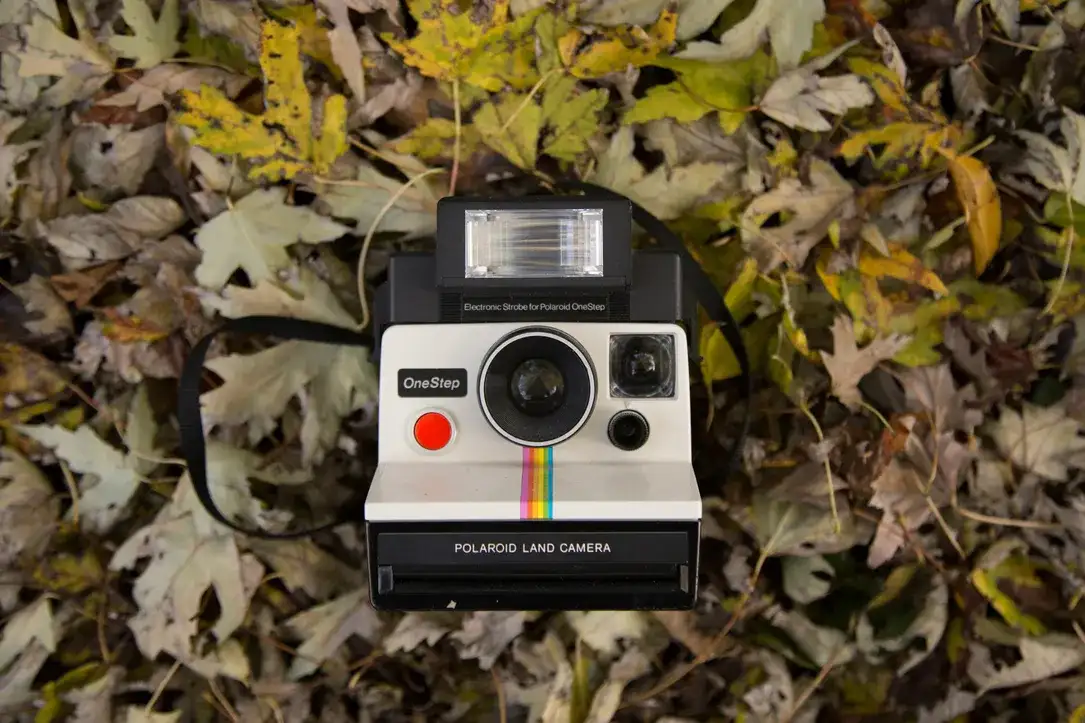
An instant camera is a camera loaded with self-developing film that hands you a finished, chemically developed print moments after you press the shutter. People often call it a Polaroid, after the brand that made the type popular.
How does an instant camera work?
Each sheet of integral instant film carries everything needed to make a picture: light-sensitive layers, an image-receiving layer and, along one edge, a sealed pod of strongly alkaline reagent (source). From the press of the button, it goes like this:
- The shutter opens and light exposes the silver halide coatings in the sheet, with separate layers responding to blue, green and red light.
- A mechanism inside the camera sends the sheet out between two rollers, which burst the pod and spread the reagent across the picture area (source).
- The reagent starts development. It contains an opacifier that stays dark while the chemistry is alkaline, so the image is shielded from light even though the print is already out of the camera.
- Dyes migrate up to the image-receiving layer; as the pH drops, the opacifier clears and the picture gradually appears.
A ghost of the image usually appears within a minute, but the colours keep deepening for several minutes after that. How long full development takes depends on the film and on the ambient temperature:
| Film | Image size | Development time |
|---|---|---|
| Polaroid colour film for 600 cameras | 79 × 79 mm on a 107 × 88 mm sheet | 10-15 minutes (source) |
| Fujifilm Instax mini | 62 × 46 mm | approx. 90 seconds (source) |
From Polaroid to Instax
The first commercial model, the Polaroid Land Model 95, went on sale in 1948, based on Edwin Land's design. In 2008 the Impossible Project took over an old Polaroid factory and restarted production of instant film, which is now made by Polaroid B.V. (source). Fujifilm released the first Instax camera, the Instax Mini 10, in 1998 (source).
For product photos for an online shop, an instant camera is the wrong tool: the print exists as a single copy and cannot be edited. The differences between the two main systems are covered in Instax vs Polaroid. "Polaroids" in modelling are a separate idea, explained under polaroids in a photo shoot.
Frequently asked questions
What is a camera sensor?
A camera sensor, or image sensor, is the light-sensitive chip that replaces film in a digital camera. It turns the light coming through the lens into an electrical signal, which the processor builds into a photo. Its size affects the angle of view, noise and depth of field.
What is the difference between APS-C and full frame?
An APS-C sensor measures roughly 23.5 × 15.6 mm (22.3 × 14.9 mm on Canon), while full frame is 36 × 24 mm. On APS-C the same lens gives a tighter frame (crop factor 1.5 or 1.6) and, at the same framing and f-number, more depth of field.
What is a fish-eye lens used for?
For shots covering up to 180 degrees with deliberately curved lines: tight interiors, action and skateboarding, creative frames. It is not suitable for packshots, because it distorts the product's proportions and the buyer needs to see its true shape.
How does an instant camera work?
After the exposure, rollers push the sheet out of the camera, burst a pod of reagent and spread it across the film. An opacifier shields the image while it develops, then clears. Instax mini film takes about 90 seconds, Polaroid colour film for 600 cameras 10-15 minutes.
Is medium format worth it for product photography?
Rarely for an online shop: a standard 2000 × 2000 px product photo is only 4 megapixels. Medium format pays off for large prints or heavy cropping, at the cost of heavier files and shallower depth of field at the same framing.
Do extension tubes reduce image quality?
Not by themselves: they contain no glass, so they add no optical flaws. They do cost you light, infinity focus and some depth of field, and tubes without electrical contacts disable autofocus and aperture control.
Should I turn off image stabilisation on a tripod?
Usually yes: most manufacturers recommend switching lens stabilisation off when the camera is on a tripod. Some newer lenses detect a tripod and do it automatically, but the manual for your particular lens or body has the final word.
How do I remove chromatic aberration from a photo?
Lateral aberration, visible towards the edges of the frame, is easy to remove with the correction tool in a RAW converter, because it comes down to rescaling the colour channels. Longitudinal aberration is hard to fix afterwards, so reduce it while shooting by stopping down.
Sources
- Image sensor format (Wikipedia): sensor dimensions, crop factors, sensor size and depth of field
- Bayer filter (Wikipedia)
- Active-pixel sensor (Wikipedia): CMOS, BSI, stacked sensors, rolling shutter
- Charge-coupled device (Wikipedia): CCD readout
- APS-C (Wikipedia)
- Fujifilm X-A5: manufacturer's specifications
- Medium format (Wikipedia)
- 120 film (Wikipedia)
- Amateur Photographer: Phase One IQ4, 53.4 × 40 mm sensor
- Fisheye lens (Wikipedia)
- Chromatic aberration (Wikipedia)
- Extension tube (Wikipedia)
- Adorama: What is an extension tube?
- F-number (Wikipedia): working f-number
- Image stabilization (Wikipedia)
- Instant film (Wikipedia): integral film, reagent and opacifier
- Science ABC: How do Polaroid pictures work?
- Wex Photo Video: Polaroid Color Film for 600, specifications
- instax mini 12: Fujifilm specifications
- Instant camera (Wikipedia)
- Instax (Wikipedia)