Instax vs Polaroid: the quick answer
Instax vs Polaroid? Instax is cheaper to shoot: a photo costs £0.85-0.95 and develops in about 90 seconds. Polaroid gives a large, almost square 79 × 77 mm image, but an i-Type photo costs £1.77-2.12 and takes 10-15 minutes to develop.
Polaroid vs Instax in short: choose Instax for parties and when you take a lot of photos. Choose Polaroid when a big, almost square image, the classic frame and playing with settings matter more than the price per shot.

Instax vs Polaroid: 2026 comparison table
| Feature | Instax (Fujifilm) | Polaroid |
|---|---|---|
| Image size | mini 62 × 46 mm, SQUARE 62 × 62 mm, WIDE 99 × 62 mm | i-Type and 600: 79 × 77 mm, Go: 47 × 46 mm |
| Cost per photo | £0.85-0.95 | i-Type and 600: £1.77-2.37, Go: £1.06-1.19 |
| Development | about 90 seconds | 10-15 minutes |
| Camera to start | mini 12 or mini 13, £79.99 RRP | Go Gen 3 £79.99, for i-Type film Now Gen 3 £119.99 |
| Current cameras | mini 12, mini 13, mini 41, mini 99, SQUARE 2, SQ40, WIDE 400 and hybrids with a screen | Go Gen 3, Now Gen 3, Now+ Gen 3, Mod, Flip, I-2 |
| Features | automatic exposure, close-up mode, selfie mirror, self-timer on the mini 13, mini 99 and WIDE 400, printing from a phone on hybrids | autofocus, double exposure, self-timer, manual control on the Now+ and I-2 |
| Best for | lots of photos, parties, a smaller budget | a large square image, experiments, the classic look |
Prices on 29 October 2026: Fujifilm eShop UK and Polaroid UK, camera RRPs from instax.co.uk. Sizes: instax.co.uk and polaroid.com.
Choose Instax if you:
- shoot at parties, on trips and at family gatherings, where a quick result and a low cost per shot matter;
- want to pick a format: the small mini for your wallet, SQUARE, or WIDE for group shots;
- are starting out and prefer a camera that sets the exposure for you.
Choose Polaroid if you:
- want a large, almost square image with the classic wide border at the bottom;
- like to experiment: double exposure, light painting, manual mode;
- accept a higher cost per photo and a longer wait.
How much does one Instax or Polaroid photo cost?
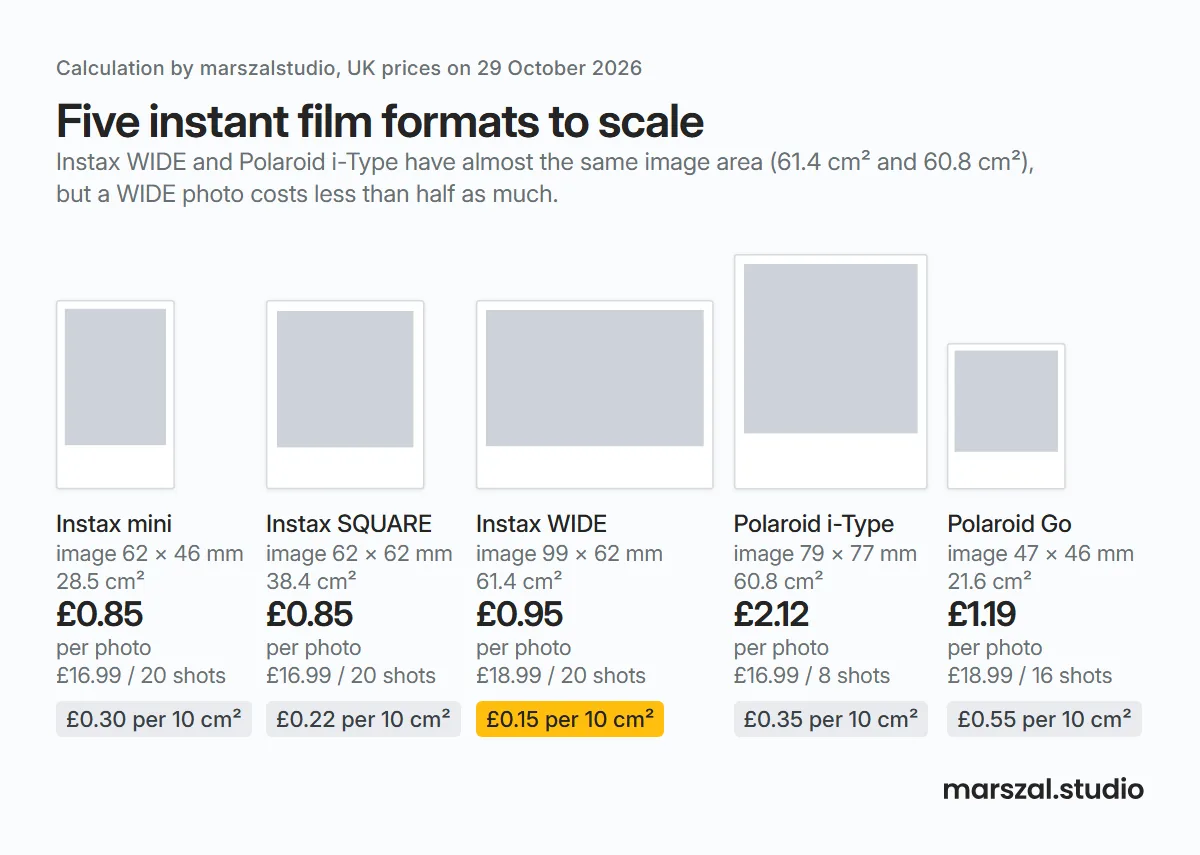
You buy the camera once, but the film decides what you spend. On 29 October 2026 we checked 12 packs in the official UK shops of Fujifilm and Polaroid, then divided each price by the number of shots and by the image area given by the manufacturer.
| Film and price (UK shop) | Image area | Per photo | Per 10 cm² |
|---|---|---|---|
| Instax mini, 20 shots, £16.99 | 28.5 cm² | £0.85 | £0.30 |
| Instax SQUARE, 10 shots, £8.99 | 38.4 cm² | £0.90 | £0.23 |
| Instax SQUARE, 20 shots, £16.99 | 38.4 cm² | £0.85 | £0.22 |
| Instax WIDE, 20 shots, £18.99 | 61.4 cm² | £0.95 | £0.15 |
| Polaroid i-Type, 8 shots, £16.99 | 60.8 cm² | £2.12 | £0.35 |
| Polaroid i-Type, 24 shots, £47.99 | 60.8 cm² | £2.00 | £0.33 |
| Polaroid i-Type, 40 shots, £74.99 | 60.8 cm² | £1.87 | £0.31 |
| Polaroid i-Type, 96 shots, £169.99 | 60.8 cm² | £1.77 | £0.29 |
| Polaroid 600, 8 shots, £18.99 | 60.8 cm² | £2.37 | £0.39 |
| Polaroid 600, 40 shots, £79.99 | 60.8 cm² | £2.00 | £0.33 |
| Polaroid Go, 16 shots, £18.99 | 21.6 cm² | £1.19 | £0.55 |
| Polaroid Go, 80 shots, £84.99 | 21.6 cm² | £1.06 | £0.49 |
What the numbers show
- WIDE and i-Type have almost the same image (61.4 and 60.8 cm²), but a WIDE photo costs £0.95 and an i-Type photo from a single pack £2.12, 2.2 times as much.
- Per area, bulk Polaroid costs about the same as Instax mini. i-Type in 40 and 96-shot packs costs £0.29-0.31 per 10 cm², Instax mini £0.30. You pay more per photo because a Polaroid image is about twice as big.
- 100 photos cost about £85 on Instax mini, £95 on Instax WIDE and £177-212 on Polaroid i-Type.
- Camera plus 100 photos: about £165 with an Instax mini 12 at RRP, and £307 with a Polaroid Now Gen 3 and i-Type five-packs.
- Polaroid Go is cheaper than i-Type only per shot. A Go photo (£1.06-1.19) still costs more than an Instax mini photo, while its 47 × 46 mm image is 24% smaller, so per area it is the most expensive format in the list.
- 600 film costs more than i-Type (£18.99 against £16.99 a pack) because each cassette has a battery for vintage 600 cameras. Cameras made for i-Type (Now, Now+, Mod, Flip, I-2) take both, so the cheaper i-Type is enough. The Go takes only Go film.
Pro tip: want an image the size of a Polaroid without paying £2 a shot? Take Instax WIDE, where a 61.4 cm² image costs £0.95. If you prefer the classic Polaroid frame, buy i-Type in five-packs or twelve-packs, not single packs.
How we calculated and what the calculation leaves out
- Prices: Fujifilm eShop UK and Polaroid UK, 29 October 2026, standard colour film with a white frame. Special editions cost more, and prices change often.
- Sizes: image and frame from the specifications on instax.co.uk and the film pages for i-Type, 600 and Go.
- Maths: image area is the width times the height of the image window; the cost per 10 cm² is calculated from the exact area, prices rounded to the penny.
- Graphic: frames and image windows to the same scale. The position of the window in the frame is simplified (centred, top margin equal to the side), because manufacturers give only the sizes.
What is an instant camera and how does it work?
An instant camera takes a photo and ejects a finished print straight away, with no negative to take to a lab. The film pack holds a negative, a positive and the developing chemistry. As the photo comes out, two rollers spread the chemistry between the layers and the image develops by itself (Polaroid support).

Edwin Land, founder of the Polaroid Corporation (1937), had the idea in 1943, when his three-year-old daughter asked why she could not see the photo he had just taken. He showed the first instant camera in 1947, and the Model 95 went on sale on 26 November 1948. Polacolor colour film followed in 1963 and the folding SX-70 in 1972 (Lemelson-MIT).
In 1947 Edwin Land showed the first instant camera, and a year later it was in the shops.
Fujifilm introduced the instax brand in 1998. By April 2025 it had sold more than 100 million instax cameras and printers in over 100 countries (Fujifilm, 8 April 2025). So Instax is not a Polaroid: it is a separate system from another company, and the films are not interchangeable.
Read more:
Why get started with instant photography?
Photos taken with a phone usually never leave it. An instant camera gives you one print. You cannot fix it with a filter or copy it without a scan, so you take fewer photos and think more about each one.

- A print in your hand straight away, for an album, a wall or a gift.
- Simple to use. On the Instax mini 12 you twist the lens to switch it on, and the camera sets the exposure and flash itself. Twist further for close-up mode at 0.3-0.5 m, and the mirror helps with selfies (instax UK).
- A lesson in framing. Every shot costs from £0.85 to £2.37, so you quickly learn to look at the light and the background before you press the shutter.
- More control if you want it. Most cameras set the exposure themselves, while the Polaroid Now+ Gen 3 and I-2 let you set it by hand.
- A digital copy when you need one. The instax UP! app scans Instax photos with your phone. For an archive, save the scan lossless (TIFF or PNG) or as a JPG at the highest quality, and keep lighter formats such as AVIF for sending.

Instax instant cameras in 2026
Fujifilm groups instax cameras by film format. Analogue models print every shot straight away, while hybrids save photos digitally and print only the ones you choose. The list on instax.co.uk on 29 October 2026:
- mini (image 62 × 46 mm, a credit-card-sized print): analogue mini 12, mini 13, mini 41 and mini 99, hybrid mini LiPlay, mini LiPlay+, mini Evo, mini Evo 2 and mini Evo Cinema.
- SQUARE (62 × 62 mm): analogue SQUARE 2 and SQUARE SQ40.
- WIDE (99 × 62 mm): analogue WIDE 400 and hybrid WIDE Evo.

A hybrid does not waste film on failed shots, but it costs about two to four times as much as a mini 12: the mini LiPlay has an RRP of £149.99, the mini Evo and mini LiPlay+ £174.99, the mini Evo Cinema £329.99.
Instax mini 12 or mini 13?
In the UK the mini 13 has the same RRP as the mini 12, £79.99 (the mini 12 was on offer at £69.99 on 29 October 2026). It keeps automatic exposure and close-up mode with parallax correction in the viewfinder, and adds a self-timer with 2 and 10 seconds and an angle wedge built into the wrist strap (instax UK).

For handheld shots the mini 12 is enough. The mini 13 makes sense for group photos and full-length selfies, because you can stand the camera on a surface and step back. The older mini 11 uses the same instax mini film (Fujifilm specifications).
Which Instax should you choose?
- First camera: mini 12 or mini 13, a photo from £0.85.
- Square photos: SQUARE 2 (RRP £94.99) or SQUARE SQ40 (£134.99). The image is 35% larger than mini, and a photo from a twin pack costs the same £0.85.
- Group shots: WIDE 400 (RRP £129.99), the lowest price per 10 cm² of image.
- You want to choose what you print: mini Evo or mini LiPlay+.

Polaroid instant cameras in 2026
Polaroid makes cameras for two formats today: i-Type and 600 with a 79 × 77 mm image, and the smaller Go with a 47 × 46 mm image. Prices from the official Polaroid UK shop on 29 October 2026:
- Go Gen 3, £79.99: according to Polaroid, the world’s smallest analogue instant camera, with a selfie mirror, self-timer and double exposure.
- Now Gen 3, £119.99: two-lens autofocus, self-timer, double exposure and USB-C charging.
- Now+ Gen 3, £139.99: the same as the Now, plus control from the Polaroid app with aperture priority and manual mode.
- Mod, £149.99: a creative mode dial with double exposure, split shot, motion freeze and light painting.
- Flip, £199.99: sonar autofocus and a hyperfocal four-lens system.
- I-2, £499.99: according to Polaroid, the first analogue instant camera with built-in manual controls.

The older Go Gen 2, also for Go film only, costs £79.99, and the Now Gen 2 is out of stock. i-Type film has no battery and fits the I-2, Flip, Mod, Now, Now+, OneStep 2, OneStep+ and the Polaroid Lab printer, but not vintage cameras. 600 film has a battery, so it also works in vintage 600-series cameras (Polaroid UK).
Temperature and light: what the box doesn’t tell you
Polaroid film works best at 13-28°C. Below 13°C photos come out over-exposed with a blue tint, above 28°C with a yellow or red tint (Polaroid support). Shield a fresh print from light while it develops: face down on a table, in a pocket or in an empty film box.
Pro tip: in winter, let a freshly ejected photo develop in the inside pocket of your jacket. Polaroid itself recommends this: body heat keeps the film in the range where it develops properly, and the pocket shields it from light.
Instax vs Polaroid in practice
Image and format
Polaroid i-Type has an almost square 79 × 77 mm image (60.8 cm²) and the wide bottom border everyone associates with the brand. Instax mini is a small print in an 86 × 54 mm frame. SQUARE has a square image 37% smaller than Polaroid, and WIDE almost the same area as Polaroid (61.4 cm²), but in a wide 99 × 62 mm format. WIDE fits more people in the frame, while the near-square Polaroid image suits portraits and single objects.

Development time
An Instax photo is ready after about 90 seconds, depending on the temperature (instax UK). Polaroid i-Type, 600 and Go film take 10-15 minutes. Don’t shake the photo: according to instax UK that is a myth, and waving the print can leave marks on it.
Durability and storage
- Instax: away from direct sunlight and humidity, ideally in an album, in a ventilated, cool and dry place (instax UK).
- Polaroid: for the first 30 days the photo is still drying, so no plastic sleeves. After that, keep it dry, dark and away from UV, and for display use a frame with UV-protective glass (Polaroid support).

Price and ease of use
To start, Instax and Polaroid cost the same: the mini 12 and the Go Gen 3 are both £79.99, and the cheapest camera for i-Type film, the Now Gen 3, costs £119.99. The gap grows with every pack: per photo, Go film costs 1.3-1.4 times and i-Type 2.1-2.5 times as much as a mini photo from a twin pack. Instax is simpler, while the Polaroid Now+ and I-2 offer manual settings that need more practice.
FAQ: Instax vs Polaroid
-
Is Instax a Polaroid?
No. Instax is the instant film system Fujifilm launched in 1998, and Polaroid is a separate company. Both make instant cameras, but their films have different sizes and are not interchangeable.
-
Which is better, Instax or Polaroid?
Instax is better to start with and for parties: photos from £0.85, ready in about 90 seconds. Choose Polaroid for a large square image, manual settings and the classic frame.
-
Which film is cheaper, Instax or Polaroid?
Instax. In the official UK shops on 29 October 2026 an Instax mini photo cost £0.85 from a twin pack, and a Polaroid i-Type photo £1.77-2.12, depending on the pack size.
-
Are Polaroid and Instax photos the same size?
No. Polaroid i-Type and 600 have a 79 × 77 mm image. Instax mini is 62 × 46 mm, SQUARE 62 × 62 mm and WIDE 99 × 62 mm, the largest image area.
-
Can I use Instax film in a Polaroid camera?
No. Instax cameras take only Instax film in their own format, and Polaroid cameras take Polaroid film: i-Type or 600, or Go film in the Polaroid Go.
-
Why is Polaroid film so expensive?
A pack holds only 8 large photos and costs £16.99 at Polaroid UK, so £2.12 a shot. 600 film also carries a battery. A five-pack lowers the price to £1.87.
-
What is the difference between Instax mini 12 and mini 13?
The mini 13 adds a self-timer with 2 and 10 seconds and an angle wedge in the wrist strap. Exposure and close-up mode work as on the mini 12. Both have a £79.99 RRP.
-
Do Polaroid photos fade?
They can fade in sunlight. Polaroid recommends letting a photo dry for 30 days without a plastic sleeve, then keeping it dry and dark or in a frame with UV-protective glass.
Summary
Instax: key advantages
- Cheaper photos: £0.85-0.95 each.
- Three formats: mini, SQUARE and WIDE.
- Ready in about 90 seconds and simple to use.
Polaroid: key advantages
- A large, almost square image: 79 × 77 mm.
- More control: creative modes on the Mod, manual settings on the Now+ and I-2.
- The classic wide border at the bottom of the photo.
To start and for lots of photos, get an Instax mini 12 or mini 13. For a large, almost square image and the classic frame, go for a Polaroid, and buy i-Type film in five-packs or bigger.