

UK product safety regulations are now firmly diverged from the EU after Brexit, and 2026 is the year that divergence becomes operationally real for online sellers. The General Product Safety Regulations 2005 (GPSR 2005) remain the baseline for the GB market, but the new Product Safety and Metrology Act 2025 introduces a modern enforcement framework, increased penalties and clearer obligations for marketplaces and online sellers. The Office for Product Safety and Standards (OPSS) under the Department for Business and Trade (DBT) continues to lead enforcement nationally, with Trading Standards handling local action. If you sell to consumers in Great Britain - whether through Amazon UK, eBay UK, Etsy, ASOS, John Lewis or your own Shopify store - this guide explains what compliance looks like in 2026 and how product photography supports it.
This guide is written from a product photography and e-commerce perspective, not from a law firm's. Since the EU GPSR (Regulation 2023/988) took effect in December 2024, many UK sellers have been confused about whether it applies to them. The short answer: EU GPSR does not apply to UK domestic sales, but it does apply if you ship to EU consumers. UK domestic compliance is governed by GPSR 2005 (still in force), the Product Safety and Metrology Act 2025, and sector-specific rules like the UK Cosmetics Regulation (UKCR). Disclaimer: this is not legal advice - consult a UK solicitor before changing your processes.
What UK product safety regulations apply in 2026
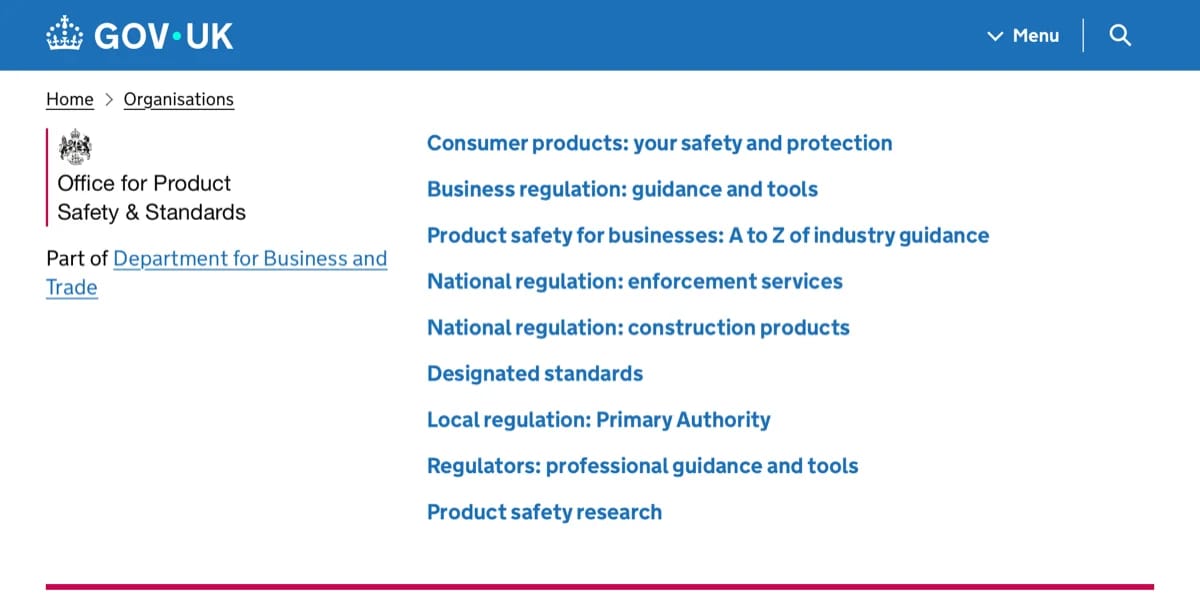
Post-Brexit, the UK has built its own product safety stack. There is no single "UK GPSR" piece of legislation that mirrors the EU's 2023/988 - instead, several instruments work together. The core regulations that any online seller in Great Britain must understand:
- General Product Safety Regulations 2005 (GPSR 2005) - the baseline statutory instrument requiring all consumer products to be safe. Still in force; predates Brexit and was retained as UK domestic law.
- Product Safety and Metrology Act 2025 - new framework Act giving Ministers powers to update product safety law, modernise enforcement and align with or diverge from EU rules sector by sector.
- Consumer Protection from Unfair Trading Regulations 2008 (CPRs) - prohibits misleading product information, including misleading photographs and descriptions in online listings.
- Consumer Rights Act 2015 - statutory rights of UK consumers (satisfactory quality, fit for purpose, as described) - directly relevant to how products are photographed and described.
- UKCA (UK Conformity Assessed) marking - replaces the CE mark for products placed on the GB market in regulated categories such as toys, electrical equipment and PPE. Northern Ireland continues to use CE/UKNI under the Windsor Framework.
- UK Cosmetics Regulation (UKCR) - replaces EU 1223/2009 for the GB market; cosmetic products require a UK Responsible Person registered with OPSS.
Who do these rules apply to? Anyone placing consumer products on the GB market, regardless of size:
- UK manufacturer selling on Amazon UK or their own Shopify store - yes
- UK importer bringing goods from China and selling via Amazon FBA UK - yes (full importer obligations under GPSR 2005 and sector regulations)
- UK seller on eBay UK or Vinted shifting second-hand items above the trading threshold - yes (HMRC trading allowance is £1,000/year; above this you become a trader)
- Etsy seller making handmade goods for the UK market - yes (no microbusiness exemption under UK product safety law)
- Drop-shipper based in the UK selling consumer electronics - yes, with importer responsibilities for products from outside the UK
- Online marketplaces (Amazon UK, eBay UK, Etsy, ASOS Marketplace) - yes, with growing due-diligence obligations under the Product Safety and Metrology Act 2025
Exclusions are narrow: food and feed (Food Safety Act 1990), medicines (MHRA), motor vehicles requiring type approval, second-hand antiques sold as antiques, and aircraft. Almost everything else in B2C e-commerce falls under GPSR 2005 plus sector-specific rules.
Key UK product safety dates 2024-2026
- 1 January 2021 - end of Brexit transition; UKCA marking introduced for the GB market
- 1 January 2023 - originally planned UKCA mandatory date (postponed multiple times)
- 1 August 2024 - DBT confirms indefinite recognition of CE marking for most product categories on the GB market (UKCA remains optional but valid)
- 13 December 2024 - EU GPSR (Regulation 2023/988) takes effect in the EU - UK exporters to the EU must comply, including appointing an EU Authorised Representative under Article 16
- Spring 2025 - Product Safety and Metrology Bill introduced to Parliament
- Summer 2025 - Bill passes; Product Safety and Metrology Act 2025 receives Royal Assent
- Late 2025 - first secondary regulations laid under the Act covering online marketplaces and importer obligations
- Q1 2026 - OPSS publishes updated guidance for online sellers; Trading Standards launches coordinated marketplace sweeps
- 2026 onwards - increased penalties, modernised reporting through OPSS Product Safety Database; alignment decisions made on a sector-by-sector basis

Online listing requirements - what every UK product page must show

Although the UK does not have a direct equivalent to EU GPSR's Article 19, the combined effect of GPSR 2005, the CPRs 2008, sector-specific labelling rules and the new Product Safety and Metrology Act 2025 means that every product listing on the GB market should include four core elements:
- Manufacturer identification - registered name, brand, postal address or email contact. Without this, the listing risks breaching CPRs 2008 (misleading omissions) and sector regulations such as the Toys (Safety) Regulations 2011 or Electrical Equipment (Safety) Regulations 2016.
- UK importer or UK Responsible Person - for products manufactured outside the UK, an identifiable importer based in Great Britain. For cosmetics specifically, a UK Responsible Person registered with OPSS is mandatory under UKCR.
- Product identification - model number, batch code, serial number or equivalent. For small handmade items, a clear photograph plus material and size description usually satisfies this.
- Safety warnings in clear English - shown directly on the listing, not hidden behind a PDF link or buried in a separate Terms page. The CPRs 2008 prohibit misleading omissions, and OPSS guidance is moving towards requiring warnings to be visible before purchase.
Practical implementation varies by marketplace. Amazon UK uses the "Compliance Information" section of Seller Central, with mandatory fields for manufacturer, country of origin, UKCA/CE status and warnings; non-compliant listings can be deactivated. eBay UK rolled out its product safety policy through 2025, including automated validation of seller information at listing creation. Etsy requires UK-bound sellers to complete product compliance fields (separate from the EU compliance fields used for EU customers) and offers an opt-out for EU but not for UK shipping. Vinted applies its UK product safety controls primarily to its Pro/business sellers, while consumer-to-consumer second-hand sales remain lighter touch.
The minimum content for a downloadable product information document - useful as a "PDF data sheet" attached to listings or stored on your own site - tracks the same logic as EU GPSR but using UK terminology:
- Full product name, brand, model, batch number where applicable
- Material composition (essential for cosmetics, toys, textiles)
- Instructions for use in English
- Safety warnings (e.g. "Keep away from open flame", "Not suitable for children under 36 months")
- Storage and disposal recommendations (including WEEE symbol for electricals)
- UK importer or Responsible Person contact (email, phone or address)
- Date of placing on the market or batch reference
UKCA vs CE marking - the 2026 reality for the GB market
One of the biggest sources of confusion for UK sellers is whether they need UKCA marking, CE marking or both. The current position as of 2026:
- UKCA marking is the GB conformity mark for regulated product categories - toys, machinery, electrical equipment, PPE, low voltage equipment, medical devices and others. It signals that a product meets the relevant UK statutory instruments.
- CE marking is still accepted on the GB market in most regulated categories, after DBT's August 2024 confirmation of indefinite recognition. This means UK sellers can place CE-marked products on the GB market without redoing conformity assessment as UKCA, in most sectors.
- UKNI marking is required for goods placed on the Northern Ireland market that have been assessed by a UK conformity assessment body. NI continues to follow EU rules under the Windsor Framework.
- Sector-specific exceptions exist - for example construction products and medical devices have separate, evolving regimes. The Product Safety and Metrology Act 2025 gives Ministers power to set or change recognition rules sector by sector.
For most online sellers, the practical takeaway in 2026 is: if your product carries valid CE marking and you sell into Great Britain, you are still compliant with marking rules, but you must also meet UK-specific obligations like having a UK importer of record, English-language warnings, and registration with OPSS for cosmetics. Products bearing only UKCA marking are also valid. Products with neither are not legally placeable on the GB market in regulated categories.
Penalties under UK product safety law - what enforcement looks like

UK enforcement is shared between several bodies:
- OPSS (Office for Product Safety and Standards) - national regulator for product safety, sitting within the Department for Business and Trade. Coordinates national approach, runs the Product Safety Database and leads on cosmetics, e-bikes, electrical and other priority categories.
- Trading Standards - local authority enforcement teams across England, Scotland and Wales. They carry out test purchases, investigate complaints and issue prohibition notices.
- CMA (Competition and Markets Authority) - oversees consumer protection law including the CPRs 2008 and price-display rules; has direct civil enforcement powers under the Digital Markets, Competition and Consumers Act 2024.
- ASA (Advertising Standards Authority) - enforces advertising codes including how products are depicted in marketing imagery and influencer content.
- HMRC - in parallel, runs the trading allowance and DAC7-style platform reporting that catches sellers operating above informal thresholds.
Penalty structure under UK product safety law as of 2026:
| Breach | Maximum penalty | Source |
|---|---|---|
| GPSR 2005 - placing unsafe product on market | £20,000 fine and/or 12 months imprisonment (summary); unlimited fine on indictment | GPSR 2005, reg. 20 |
| Product Safety and Metrology Act 2025 - serious breach by manufacturer/importer/marketplace | Increased civil monetary penalties (turnover-linked for largest businesses) | PSMA 2025, secondary regs |
| Misleading product information (CPRs 2008) | Unlimited fine on indictment; up to 2 years imprisonment | CPRs 2008, reg. 13 |
| Cosmetics non-compliance (UKCR) | Up to £20,000 fine and/or 3 months imprisonment per offence | Cosmetic Products Enforcement Regs 2013 |
| Failure to comply with prohibition notice | Unlimited fine on indictment; criminal record | GPSR 2005, reg. 14 |
The Product Safety and Metrology Act 2025 enables turnover-linked civil penalties for the largest online marketplaces and manufacturers, modelled on the CMA's powers under the Digital Markets, Competition and Consumers Act 2024. While the £20,000 GPSR 2005 cap remains for individual summary offences, on indictment fines are unlimited and prison sentences up to 12 months are real outcomes. This is not abstract: in 2024-2025 OPSS issued enforcement notices against multiple online marketplaces in connection with unsafe e-bike batteries, button cell battery toys and counterfeit electrical adaptors, and Trading Standards prosecutions resulted in custodial sentences for repeat offenders.

Selling from the UK into the EU - when EU GPSR applies
Many UK businesses still ship to EU consumers, and this is where EU GPSR (Regulation 2023/988) does apply. Since 13 December 2024, every product placed on the EU market - including from a UK seller shipping into Germany, France, Ireland, Spain or any other EU state - must comply with the EU GPSR regime. The headline obligations:
- EU Authorised Representative under Article 16 - mandatory for non-EU sellers. The Representative must be a person or company established in the EU who accepts responsibility for product compliance, can be contacted by EU authorities and is named on the listing.
- Article 19 listing requirements - manufacturer details, EU Responsible Person, product identifier and warnings shown directly on the EU-facing product page.
- Technical documentation - retained for 10 years from placing on the EU market.
- Incident reporting through the EU Safety Business Gateway within 2 days of becoming aware of a risk.
- EU language requirements - warnings and instructions in the official languages of the EU member states where the product is offered.
For UK exporters this means a dual stack: UK domestic compliance (GPSR 2005, PSMA 2025, UKCR, sector regs) plus EU GPSR compliance for any EU-bound listing. Practical options for the EU Authorised Representative include third-party compliance services such as European Authorized Services (EAS), Euverify RP and EU Compliance Partner, with annual fees typically ranging from EUR 199 to EUR 1,499 depending on scope and product count.

Product photography and UK compliance - how images support legal duty of care

Product photography is rarely treated as a compliance topic, but in practice it is one of the most useful tools UK sellers have. Good photography supports three distinct compliance functions:
- Product identification - high-resolution images showing the label, UKCA or CE mark and batch code act as evidence of what was placed on the market. If a buyer claims the product they received was different from what was advertised, your photographs are the first evidence reviewed in a CRA 2015 dispute or CPRs 2008 investigation.
- Visibility of warnings - if a product carries on-label warnings such as "Not suitable for children under 36 months" or CLP hazard pictograms, those warnings must be legible in your listing photographs. Cropping, blur or low-quality imagery that hides warnings can support a misleading-omission claim.
- Condition and material - for second-hand sales on eBay UK, Vinted or Depop, your photographs are the contemporaneous record of condition. Without time-stamped images, you cannot evidence that an item left you in the state you described, leaving you exposed under the Consumer Rights Act 2015 and the Sale of Goods Act 1979 (where it still applies to non-consumer transactions).
Practical photography requirements that align with UK product safety expectations:
- Hero shot on a clean neutral background, minimum 1500x1500 px, JPG q85+ or WebP q82+
- Label image with a legible UKCA or CE mark, model number, batch code and the importer/manufacturer address
- Detail shots for complex products - connectors, mechanisms, anywhere the product can fail (essential for satisfactory-quality evidence)
- Warning images - a separate close-up of any on-product warning panel
- Scale reference with a hand or ruler for small items (toys, jewellery, cosmetics)
- Ingredients or material panel for textiles, cosmetics and supplements (INCI listing for cosmetics)
At marszalstudio we shoot UK-compliance-ready packshots on request, priced individually - typically 8 to 12 images per product covering all of the above, plus a short technical PDF documenting session conditions. The honest truth is that AI cannot replace a good base photograph: tools like Photoroom, Canva or Adobe Firefly are excellent for backgrounds, retouching and variations, but a court or Trading Standards officer comparing your listing to the physical product wants to see real, clear photography of the actual SKU - including a properly exposed label. AI-generated imagery without an underlying real photograph creates evidential and CPRs 2008 risks.

Amazon UK, eBay UK, Etsy and ASOS - how each marketplace implements UK rules

Each major UK marketplace has its own implementation, and 2026 is the year these tighten further as secondary regulations under the Product Safety and Metrology Act 2025 are laid:
- Amazon UK - "Compliance Information" section in Seller Central is mandatory for many categories. Listings without manufacturer details, country of origin, and UKCA/CE status risk deactivation. Amazon has the strongest enforcement of the UK marketplaces, with automated content scans and category-level safety rules for toys, electricals and cosmetics.
- eBay UK - product safety policy updated mid-2025; automated validation at listing creation requires manufacturer or importer information for new business sellers. Private sellers operating above HMRC's £1,000 trading allowance increasingly fall within the same expectations.
- Etsy (UK shipping) - separate UK and EU compliance fields; sellers shipping to GB must complete the UK section even if they have opted out of EU sales. Handmade exemptions do not exist - a UK Etsy seller of bath products still needs UKCR-compliant labelling and a UK Responsible Person.
- ASOS Marketplace - now requires brand owners to evidence UK importer of record details and provide compliance documentation on request, in line with its 2025 Marketplace policies.
- Vinted - in the UK, business sellers (Vinted Pro) are subject to consumer protection rules; consumer-to-consumer second-hand sales remain lighter touch but the £1,000 HMRC trading allowance and DAC7-style data sharing with HMRC means sellers who scale will be reclassified.
- John Lewis, M&S, Tesco - high-street retailers running their own marketplaces apply tighter pre-onboarding checks than the open platforms, often requiring full technical documentation and audit-ready photography before approval.
A practical rollout sequence for a UK shop with around 100 SKUs: 1) complete every product's compliance fields on Amazon UK first (highest enforcement risk and the most automated deactivation), 2) prepare PDF data sheets for eBay UK and Etsy where listings are more free-form, 3) update your own Shopify or WooCommerce store to include a "Product safety information" section above the fold on each product page, 4) document the same information internally for OPSS or Trading Standards enquiries. With ready compliance photography and a basic technical pack, a 100-SKU rollout takes 2 to 4 weeks.

12-step UK compliance checklist for online sellers
A practical step-by-step list for UK sellers in 2026, drawing on OPSS guidance and our experience supporting e-commerce clients with photography and technical documentation:
- Audit your current listings against the four core elements - manufacturer, UK importer/RP, identifier, warnings
- Confirm marking - decide whether you are using UKCA, CE (still recognised on the GB market), UKNI for NI, or a sector-specific mark, and ensure it is correct on packaging and listings
- Appoint a UK Responsible Person where required - mandatory for cosmetics under UKCR, increasingly expected for online marketplace categories
- Build your technical file - test reports, conformity assessments, declarations, retained for at least 10 years
- Create a product information sheet per SKU in clear English (PDF and on-page text)
- Commission UK-compliance-ready photography - hero plus label, warnings, materials, scale
- Complete marketplace compliance fields - Amazon UK Compliance Information, eBay UK product safety, Etsy UK fields, ASOS documentation
- Update your own store - Shopify, WooCommerce or Magento - with a "Product safety information" section on every PDP
- Set up an incident response process - 24 to 48 hour internal SLA for reviewing and reporting safety issues to OPSS via the Product Safety Database
- Draft a recall and withdrawal policy - how you contact UK customers (email, on-site banner, social channels) if something goes wrong
- Train your customer service team - to spot and escalate complaints that suggest a safety issue rather than a routine return
- Run a quarterly compliance review - new SKUs, regulatory updates from OPSS, and Trading Standards news
Realistic timeline: 4 to 8 weeks for 100-500 SKUs, 8 to 16 weeks for 1,000+. External legal advice typically costs £3,000-£10,000 depending on category complexity. A UK-compliance-ready photography session with marszalstudio for a typical 50-SKU pack is priced individually - a small investment relative to a single £20,000 fine or a marketplace deactivation.

Safety warnings and symbols on UK product listings

The most common warnings that should appear directly on a UK product listing - and not be hidden behind a PDF or buried in store policies:
- Toys and children's products: "Not suitable for children under 36 months. Contains small parts" plus the 0-3 prohibition symbol where relevant
- Cosmetics: full INCI ingredient list, on-pack and online warnings ("For external use only", "Avoid contact with eyes"), Period After Opening (PAO) symbol
- Electricals: voltage and frequency, UKCA or CE mark, WEEE crossed-out wheelie bin, water/heat exposure warnings
- Textiles: fibre composition (e.g. polyester X%, cotton Y%), washing symbols (BS EN ISO 3758), country of origin
- Food supplements: contraindications, dosage, "Not suitable during pregnancy" where applicable - alongside FSA labelling rules
- Chemicals and household products: GHS/CLP pictograms, Hazard (H) and Precautionary (P) statements as required under retained CLP regulations
Format: plain English text in the listing body, ideally in a dedicated "Product safety information" section. Marketplaces vary, but the principle holds across all of them - the consumer must see warnings before purchase, not on opening the parcel. A clear photograph of the on-product warning panel is a strong supporting element, particularly for chemicals where CLP pictograms must be reproduced legibly.

How UK product safety interacts with other regulations

UK product safety law does not operate in isolation. Key interactions every online seller should understand:
- Consumer Rights Act 2015 - statutory rights to satisfactory quality, fit for purpose, and as described. Photography is the primary evidence in disputes.
- Consumer Protection from Unfair Trading Regulations 2008 - bans misleading actions and omissions in advertising. Edited or misleading product imagery can be a breach.
- Digital Markets, Competition and Consumers Act 2024 - gives the CMA direct civil enforcement powers over consumer protection breaches, with turnover-linked penalties.
- UK GDPR and Data Protection Act 2018 - relevant when capturing customer details for incident reporting, recalls or warranty.
- Online Safety Act 2023 - separate from product safety, but online marketplaces are increasingly treated as user-to-user services with related duties.
- EU GPSR (Regulation 2023/988) - applies to UK sellers shipping to EU consumers; requires an EU Authorised Representative under Article 16 in addition to UK domestic compliance.
- Sector regulations - Toys (Safety) Regulations 2011, Electrical Equipment (Safety) Regulations 2016, UKCR for cosmetics, Restriction of Hazardous Substances 2012 (UK RoHS), and others.
The takeaway: UK compliance is a system, not a single regulation. Most sellers start with the most visible elements - listing fields on Amazon UK and eBay UK, UKCA or CE marking - but the durable approach is to build a small internal compliance pack per SKU covering identification, warnings, photography and importer details. Once that pack exists, all marketplaces and your own store can be populated from it consistently.
EU GPSR (Regulation 2023/988) does not apply to UK domestic sales. After Brexit, the GB market is governed by the General Product Safety Regulations 2005 (GPSR 2005), the Product Safety and Metrology Act 2025 and sector-specific UK rules. EU GPSR does apply to UK sellers shipping to EU consumers - in that case you must comply with EU GPSR including appointing an EU Authorised Representative under Article 16, providing Article 19 listing information, and reporting incidents through the EU Safety Business Gateway. UK domestic compliance and EU export compliance are separate stacks.
The core UK regime is built on the General Product Safety Regulations 2005 (GPSR 2005), still in force as retained UK law; the Product Safety and Metrology Act 2025, providing a modernised framework; the Consumer Protection from Unfair Trading Regulations 2008 (CPRs) for misleading information; the Consumer Rights Act 2015 for buyer rights; UKCA marking for regulated GB-market products (with CE marking still recognised in most categories after DBT's August 2024 confirmation); UKCR for cosmetics; and sector regulations for toys, electricals, PPE and others. Enforcement is split between OPSS, Trading Standards, the CMA and the ASA.
UKCA marking is valid for the GB market, but in most regulated product categories CE marking continues to be recognised after the DBT confirmed indefinite recognition in August 2024. This means UK sellers can place products bearing valid CE marking on the GB market without redoing conformity assessment as UKCA. Northern Ireland continues to follow EU rules under the Windsor Framework, using CE or UKNI marking. Sector-specific exceptions apply, for example construction products and medical devices have separate evolving regimes. The Product Safety and Metrology Act 2025 enables Ministers to update recognition rules sector by sector.
Although the UK does not have a direct equivalent to EU GPSR Article 19, the combined effect of GPSR 2005, the CPRs 2008 and sector rules means every listing should show four core elements: 1) manufacturer details (name, brand, address or email), 2) UK importer or UK Responsible Person for products from outside the UK, 3) product identification (model, batch or serial number), 4) safety warnings in clear English directly on the listing rather than hidden in a PDF. Amazon UK enforces this via the Compliance Information section in Seller Central; eBay UK validates seller details at listing creation; Etsy and ASOS use dedicated compliance fields.
Yes, where the seller is acting as a trader. HMRC's £1,000 trading allowance is the practical line - sellers turning over more than £1,000 a year, or making more than 30 transactions or EUR 2,000 a year under DAC7-style platform reporting, are usually treated as traders. Traders selling second-hand consumer goods on eBay UK, Vinted, Depop or Facebook Marketplace fall within GPSR 2005 and the Consumer Rights Act 2015. They should keep dated photographs of items as condition evidence, describe defects honestly, and provide clear contact details. Casual private sellers below the threshold remain lighter touch but should still photograph items at point of sale.
Photography is one of the strongest pieces of evidence in any UK product safety or consumer protection enquiry. High-resolution images showing the UKCA or CE mark, batch code and importer details document what was placed on the market. Macro images of warnings and CLP pictograms ensure consumers can see them before purchase, defending against CPRs 2008 misleading-omission claims. For second-hand sellers, time-stamped images are the contemporaneous record of condition under the Consumer Rights Act 2015. A practical compliance-ready packshot set is 8 to 12 images per SKU covering hero, label, warnings, scale and material - plus a short technical PDF.
Yes. EU GPSR Article 16 requires every product placed on the EU market by a non-EU seller to have an EU-based Responsible Person who accepts compliance responsibility, can be contacted by EU authorities and is named on the listing. UK sellers shipping to consumers in Germany, France, Ireland, Spain or any other EU state must appoint one. Practical options include compliance services such as European Authorized Services (EAS) at around EUR 199 per year, Euverify RP at EUR 499 to EUR 1,499 per year, and EU Compliance Partner at roughly EUR 120 per product as a one-off. UK domestic sales remain governed by UK rules and do not require an EU Representative.
Under GPSR 2005, placing an unsafe product on the market can lead to a fine of up to £20,000 and/or 12 months imprisonment on summary conviction, and unlimited fines on indictment. The Consumer Protection from Unfair Trading Regulations 2008 add unlimited fines and up to 2 years imprisonment for misleading omissions. The Product Safety and Metrology Act 2025 introduces increased civil monetary penalties, including turnover-linked fines for the largest manufacturers and online marketplaces, modelled on the CMA's Digital Markets, Competition and Consumers Act 2024 powers. Cosmetic products non-compliance under UKCR can attract fines of up to £20,000 per offence.
Twelve practical steps: 1) audit current listings against the four core elements, 2) confirm UKCA, CE or UKNI marking is correct, 3) appoint a UK Responsible Person where required (mandatory for cosmetics under UKCR), 4) build technical files retained for 10 years, 5) draft per-SKU product information sheets in clear English, 6) commission compliance-ready packshot photography (8-12 images per SKU), 7) complete marketplace compliance fields on Amazon UK, eBay UK, Etsy and ASOS, 8) update your own Shopify or WooCommerce store with a Product safety information section, 9) set up an incident response process, 10) draft a recall and withdrawal policy, 11) train customer service teams, 12) run quarterly compliance reviews. Realistic timeline: 4 to 8 weeks for 100-500 SKUs.
Summary - turning UK product safety into an operational habit
UK product safety in 2026 is more than abstract law - it is a real enforcement system run by OPSS, Trading Standards, the CMA and the ASA, supported by automated marketplace controls on Amazon UK, eBay UK, Etsy and ASOS. The Product Safety and Metrology Act 2025 modernises the framework, and although the £20,000 fine cap under GPSR 2005 remains for individual summary offences, on indictment penalties are unlimited and turnover-linked civil penalties are now possible for the largest businesses. Microbusinesses and Etsy makers are not exempt - the same baseline rules apply, with proportionate enforcement.
Three actions to prioritise: 1) complete the four core elements on every Amazon UK and eBay UK listing first - this is where automated deactivation hits hardest; 2) commission compliance-ready photography for the 20% of SKUs that drive 80% of your revenue, including a sharp label and warning shot per product; 3) if you import from outside the UK, confirm your UK importer of record is named on listings, and if you ship to EU consumers, appoint an EU Authorised Representative under EU GPSR Article 16. At marszalstudio we shoot compliance-ready packshots with full technical documentation for UK and EU listings, with typical turnaround of 24-72 hours for a 50-SKU pack.
Disclaimer: this article is educational and does not constitute legal advice. Every business situation needs individual analysis. Speak to a UK solicitor specialising in consumer and product safety law before changing your operations. The full text of the General Product Safety Regulations 2005 is available on legislation.gov.uk, the Product Safety and Metrology Act 2025 is on the same site, and OPSS guidance is published on gov.uk.
Related reading: Technical photography requirements for Amazon, Empik and Allegro | Complete guide to selling on Allegro | EU AI Act for product photography 2026 | AI in product photography - the complete guide